
Blog and News
ESD Flooring Standards & Compliance: Everything You Need to Know
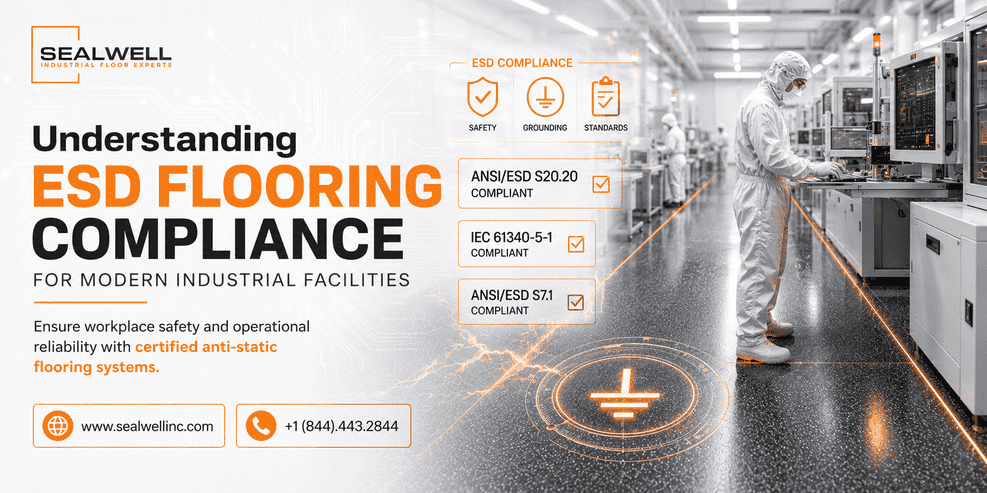
Electrostatic discharge, often called ESD, can create serious problems in modern industrial, manufacturing, electronics, medical, aerospace, and laboratory environments. A small static discharge may be invisible, but it can damage sensitive components, interrupt production, cause product failures, or create safety concerns in certain facilities.
That is why many businesses search for ESD Flooring in Florida when they need to control static electricity and protect critical operations. But selecting the right ESD floor is not only about choosing a durable surface. It is also about understanding standards, testing, grounding, compliance, and long-term performance.
For facility managers, operations leaders, engineers, and business owners, ESD flooring compliance can feel complicated. This guide from Sealwell explains the key standards, what they mean, and how to make a smarter flooring decision for your facility.
Quick Answer: What Standards Apply to ESD Flooring?
The most commonly referenced ESD flooring and static-control standards include ANSI/ESD S20.20, IEC 61340-5-1, and, for fire or explosion hazard concerns, NFPA 77. ANSI/ESD S20.20 provides requirements for establishing, implementing, and maintaining an ESD control program for organizations handling ESD-sensitive electrical or electronic parts. IEC 61340-5-1 is also widely used for ESD control program requirements and is described by the EOS/ESD Association as technically equivalent to ANSI/ESD S20.20. NFPA 77 provides guidance for identifying, evaluating, and controlling static electricity hazards to help prevent fires and explosions.
In simple terms, ESD flooring should be selected, installed, grounded, maintained, and tested as part of a complete static-control plan, not treated as a stand-alone product.
What Is ESD Flooring?
ESD flooring is a static-control flooring system designed to help dissipate electrostatic charges safely. It creates a controlled path for static electricity to move away from people, equipment, carts, workstations, and sensitive products.
This is different from basic anti-static flooring. Anti-static flooring may reduce the generation of static on the floor surface, but it does not always provide a fully grounded path for controlled discharge. The Ecotile reference article explains the difference clearly: anti-static floors reduce static buildup on the floor surface, while ESD floors are grounded systems designed to dissipate static in a controlled way.
Facilities often need ESD flooring when they handle:
- Circuit boards and microelectronics
- Medical devices
- Aerospace components
- Robotics and automation systems
- Data center equipment
- Sensors, controls, and testing equipment
- EV battery components
- Telecommunications equipment
- Laboratory instruments
- Flammable materials or static-sensitive processes
For companies evaluating ESD Flooring in Florida, the goal is to reduce risk, support compliance, and maintain consistent performance in real-world working conditions.
Why ESD Flooring Compliance Matters
ESD compliance matters because static damage is not always obvious. A component may fail immediately, or it may experience hidden damage that causes failure later in the field. That can lead to downtime, customer complaints, warranty claims, production waste, or failed audits.
A compliant ESD flooring system helps facilities:
- Protect sensitive components and assemblies
- Support quality-control processes
- Reduce unplanned downtime
- Improve worker safety and comfort
- Create a more controlled production environment
- Prepare for customer, supplier, or internal audits
- Support broader ESD control programs
For manufacturers and technical facilities, ESD flooring is not just a facility upgrade. It is part of operational risk management.
Key ESD Flooring Standards You Should Know
-
ANSI/ESD S20.20
ANSI/ESD S20.20 is one of the most important standards for ESD control programs. It provides administrative and technical requirements for organizations that handle electrical or electronic parts, assemblies, and equipment susceptible to ESD damage.
This standard covers areas such as:
- Training
- Product qualification
- Compliance verification
- Grounding and bonding systems
- Personnel grounding
- ESD protected areas
- Packaging
- Marking
For flooring, ANSI/ESD S20.20 is important because it does not treat the floor as an isolated product. Instead, the floor must work with the rest of the ESD control system, including footwear, grounding, equipment, and routine verification.
-
IEC 61340-5-1
IEC 61340-5-1 is another major standard used for ESD control programs. The EOS/ESD Association notes that IEC 61340-5-1 is technically equivalent to ANSI/ESD S20.20.
This standard is especially relevant for companies that operate globally, supply international customers, or follow international compliance requirements.
IEC 61340-5-1 focuses on creating and maintaining an ESD control program for handling ESD-sensitive devices. That means flooring decisions should be based on the environment, the products being handled, personnel movement, grounding strategy, and verification procedures.
-
NFPA 77
NFPA 77, Recommended Practice on Static Electricity, is often referenced when static electricity may create fire or explosion hazards. NFPA describes the practice as guidance for identifying, evaluating, and controlling static electricity hazards to help prevent fires and explosions.
This may be relevant in facilities that handle:
- Flammable vapors
- Powders
- Solvents
- Fuel-related materials
- Combustible dust
- Chemical processing operations
For these environments, ESD flooring may be one part of a broader static-control and safety strategy. Facility managers should work with qualified safety, electrical, and flooring professionals when static control intersects with fire or explosion risk.
-
Facility-Specific Requirements
In addition to recognized ESD standards, many facilities must meet requirements from customers, suppliers, internal quality systems, insurance providers, or industry-specific programs.
For example, a Florida electronics manufacturer may need to satisfy customer audit requirements. A medical device facility may need flooring that supports controlled manufacturing procedures. A warehouse using automated equipment may need static-control flooring to reduce shocks and protect sensors.
This is why Sealwell recommends evaluating the full facility before choosing a system.
ESD Flooring Compliance Is a System, Not Just a Floor
One of the biggest mistakes businesses make is assuming that installing an ESD floor automatically makes the facility compliant.
In reality, ESD flooring works best when it is part of a complete static-control system. That system may include:
- Grounding points
- Conductive or dissipative flooring materials
- ESD footwear or heel straps
- Grounded workstations
- Proper carts and chairs
- ESD-safe tools and packaging
- Humidity control
- Cleaning procedures
- Routine testing
- Employee training
A high-quality floor can fail to perform properly if it is not grounded, maintained, or used with compatible footwear and equipment.
That is why businesses searching for ESD Flooring in Florida should work with an experienced flooring partner that understands both floor performance and facility conditions.
ESD Flooring Testing: What Should Be Checked?
Testing is an essential part of ESD flooring compliance. Flooring should be tested before installation decisions are finalized, after installation, and during ongoing maintenance.
Common testing considerations include:
- Surface resistance
- Resistance to ground
- Grounding connection performance
- Person-footwear-floor system performance
- Continuity of static-control areas
- Cleanliness and maintenance impact
- Changes caused by wear, coatings, or contaminants
Testing helps confirm that the floor is not just labeled as ESD, but actually performs as expected in the facility.
Conductive vs Static-Dissipative Flooring
ESD flooring systems are often described as conductive or static-dissipative. Both are designed to control static electricity, but they perform differently.
Conductive flooring allows electrical charges to move more easily through the floor to ground. It may be used where faster discharge is needed.
Static-dissipative flooring allows charges to move more slowly and in a controlled way. It is commonly used where sensitive electronic components need protection from sudden discharge.
The right option depends on your operation, safety requirements, equipment, and ESD control plan. A professional assessment can help determine which system is appropriate.
Common Mistakes That Lead to ESD Flooring Compliance Problems
Even well-intentioned facilities can run into compliance issues when the flooring system is not planned properly.
Common mistakes include:
- Choosing anti-static flooring when ESD flooring is required
- Installing ESD flooring without proper grounding
- Ignoring footwear and personnel grounding requirements
- Using cleaning products that leave insulating residue
- Failing to test the floor after installation
- Not maintaining test records
- Assuming all ESD floors perform the same
- Not considering carts, chairs, workstations, or equipment
- Selecting a floor without considering traffic and wear
The reference article also points out that anti-static flooring is often misunderstood and may not remove static from people, tools, or equipment. This is a critical distinction for facilities with sensitive operations.
Industries That Need ESD Flooring in Florida
Florida is home to a growing mix of manufacturing, logistics, aerospace, automotive, technology, medical, and distribution operations. Many of these environments depend on reliable static-control flooring.
ESD flooring may be valuable for:
- Electronics manufacturing facilities
- Aerospace and defense suppliers
- Medical device production areas
- Automotive and EV component manufacturers
- Data centers and telecom facilities
- Laboratories and cleanrooms
- Warehouses with automated systems
- Packaging and fulfillment centers
- Robotics and sensor-based production areas
For many of these businesses, ESD Flooring in Florida is not just about preventing shocks. It is about protecting production quality, reducing risk, and supporting long-term operational reliability.
How Sealwell Helps Facilities with ESD Flooring Compliance
Sealwell helps businesses evaluate flooring needs, static-control risks, and facility conditions before recommending a solution. The right flooring system should match the environment—not the other way around.
Sealwell can help with:
- Facility flooring assessments
- ESD vs anti-static flooring guidance
- Static-control floor planning
- Surface preparation recommendations
- Flooring system selection
- Installation planning
- Maintenance considerations
- Floor plan support for production and traffic flow
Whether your facility is upgrading an existing space or planning a new project, Sealwell can help you make informed decisions before installation begins.
What to Ask Before Installing ESD Flooring
Before choosing an ESD flooring system, ask these questions:
- What products or equipment need static protection?
- Are we required to meet ANSI/ESD S20.20, IEC 61340-5-1, customer requirements, or internal standards?
- Will the floor need to support heavy carts, forklifts, or production equipment?
- How will the floor be grounded?
- What footwear or personnel grounding controls will be used?
- How often will the floor be tested?
- What cleaning products are approved for the floor?
- Are there fire, explosion, or chemical hazards to consider?
- Can installation be completed with minimal downtime?
- Who will document and verify performance?
These questions help ensure the selected floor supports both compliance and everyday operations.
Final Takeaway: Compliance Starts with the Right Plan
ESD flooring compliance is not about installing a product and hoping it works. It is about designing a flooring solution that fits your facility, supports recognized standards, and performs consistently over time.
ANSI/ESD S20.20 and IEC 61340-5-1 provide important guidance for ESD control programs, while NFPA 77 may apply when static electricity creates fire or explosion concerns. But every facility is different. The right flooring system depends on your products, people, equipment, traffic, and risk level.
For businesses looking for ESD Flooring in Florida, Sealwell provides practical guidance, professional evaluation, and flooring solutions built around real facility needs.
Connect with Sealwell for a Free Consultation
Need help understanding ESD flooring standards or choosing the right static-control system?
Connect with the Sealwell team for a free consultation, site visit, and floor plan. Our team can review your facility, discuss compliance goals, and recommend a flooring solution that supports safety, performance, and long-term value.
FAQs
What is ESD flooring compliance?
ESD flooring compliance means the flooring system is selected, installed, grounded, maintained, and tested according to the static-control requirements that apply to the facility. It often supports standards such as ANSI/ESD S20.20 or IEC 61340-5-1.
What is the main ESD flooring standard?
ANSI/ESD S20.20 is one of the most commonly referenced ESD control program standards in the United States. IEC 61340-5-1 is also widely used, especially for international ESD control programs.
Is ESD flooring required by law?
ESD flooring is not always required by law. However, it may be required by customer contracts, supplier standards, internal quality systems, safety programs, or industry compliance expectations.
What is the difference between ESD flooring and anti-static flooring?
Anti-static flooring helps reduce static generation. ESD flooring is designed to dissipate static electricity through a controlled and grounded path. ESD flooring usually provides a higher level of protection for sensitive environments.
Who needs ESD Flooring in Florida?
Businesses that handle electronics, medical devices, aerospace parts, robotics, data center equipment, EV components, laboratory instruments, or static-sensitive products may need ESD Flooring in Florida.
How often should ESD flooring be tested?
Testing frequency depends on the facility’s ESD control program, risk level, and customer requirements. Many facilities test after installation and then perform routine verification on a scheduled basis.
Can ESD flooring fail compliance testing?
Yes. ESD flooring may fail if it is not installed correctly, not grounded properly, contaminated by cleaning products, damaged by wear, or used without compatible footwear and equipment.
Is conductive flooring the same as ESD flooring?
Not always. Conductive flooring is one type of static-control flooring. ESD flooring may be conductive or static-dissipative depending on the application and required level of control.
Does ESD flooring need special cleaning?
Yes. ESD flooring should be cleaned with approved products that do not leave insulating residue. The wrong cleaner can interfere with static-control performance.
How can Sealwell help with ESD flooring compliance?
Sealwell can evaluate your facility, review static-control needs, recommend suitable flooring options, and help plan an ESD flooring solution that supports your operational and compliance goals.
SEALWELL INC
Phone No– +1 (844)-443-2844
Email- in*******@se*********.com
Let’s Connect: www.sealwellinc.com
Our trusted clients: