
Blog and News
ESD Flooring vs Anti-Static Flooring: What’s the Difference?
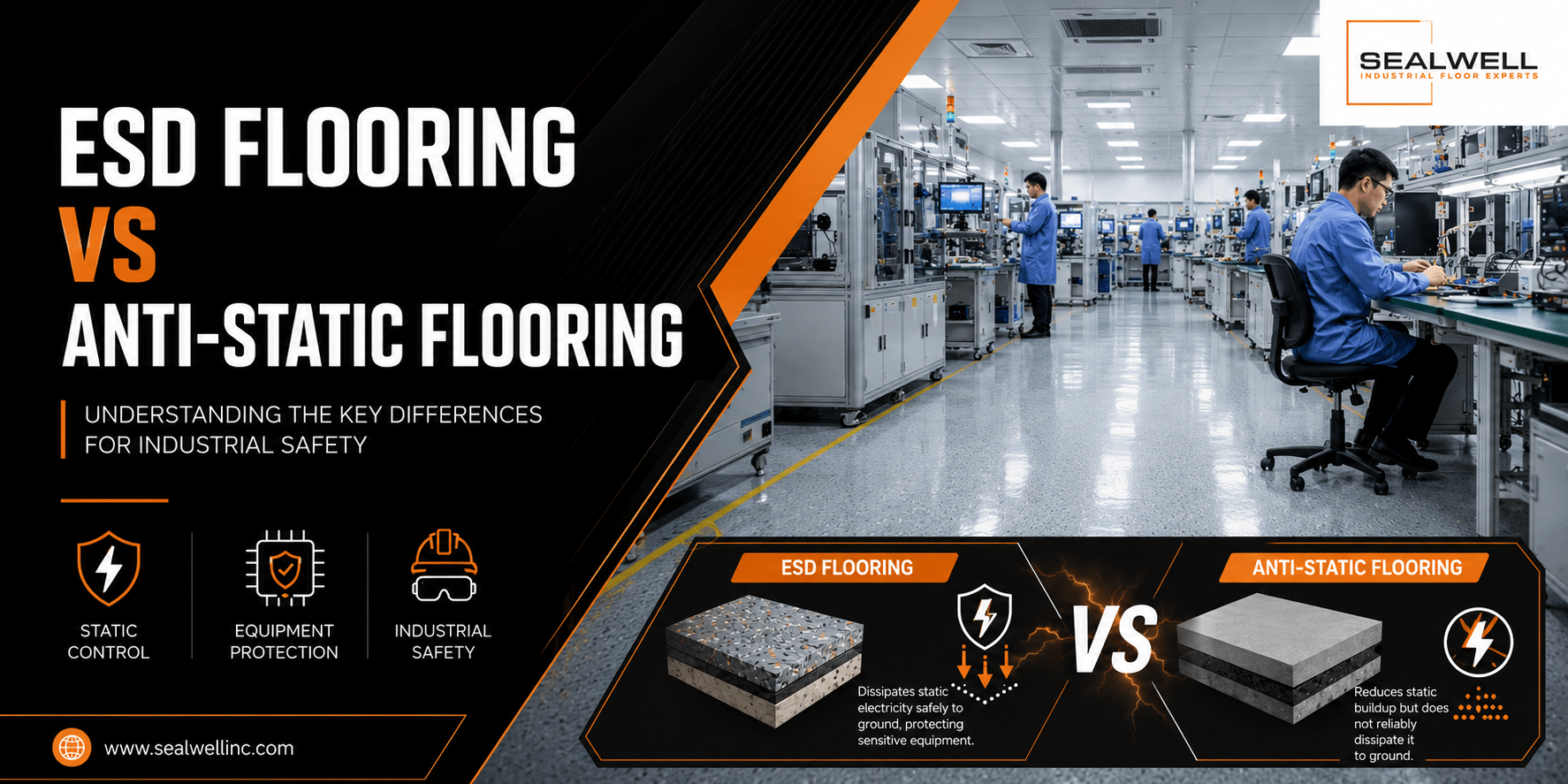
Static electricity may seem like a minor workplace issue, but in the wrong environment, it can cause major problems. A small electrostatic discharge can damage electronic components, interrupt production, create discomfort for workers, or compromise sensitive operations in manufacturing, logistics, laboratories, cleanrooms, and technology-driven facilities.
That is why many businesses search for ESD Flooring in Georgia when they begin upgrading their industrial floors. However, one common question comes up early in the planning process:
Is ESD flooring the same as anti-static flooring?
The short answer is no. Anti-static flooring helps reduce static generation, while ESD flooring is designed to control, dissipate, and safely ground static charges. The right choice depends on your facility, equipment, risk level, and compliance needs.
At Sealwell, we help commercial and industrial facilities choose flooring systems that support safety, performance, and long-term value.
Quick Answer: ESD Flooring vs Anti-Static Flooring
Anti-static flooring reduces the chance of static electricity building up on the floor surface. It is useful in spaces where static is more of a nuisance than a serious operational risk.
ESD flooring, or electrostatic discharge flooring, provides a controlled path for static electricity to dissipate safely. It is commonly used where sensitive electronics, medical devices, circuit boards, automated equipment, or flammable materials may be affected by static discharge.
For facilities handling static-sensitive products or equipment, ESD Flooring in Georgia is usually the better long-term solution.
What Is Anti-Static Flooring?
Anti-static flooring is designed to minimize the generation of static electricity. In simple terms, the floor itself is less likely to create static as people walk, carts move, or materials slide across the surface.
This type of flooring may be suitable for:
General offices
Light industrial areas
Retail or commercial spaces
Storage rooms
Facilities where static shocks are irritating but not damaging
Areas without static-sensitive equipment
Anti-static flooring can make a space more comfortable for employees and reduce minor static-related issues. However, it does not always provide a complete grounding system. That means it may not remove static charges from people, tools, carts, packaging, or equipment.
This is the key limitation. Anti-static flooring may reduce static generation, but it does not necessarily provide the controlled discharge protection required in high-risk environments.
What Is ESD Flooring?
ESD flooring stands for electrostatic discharge flooring. It is a specialized static-control flooring system designed to safely dissipate electrical charges through the floor and into a grounded path.
In many applications, ESD flooring works as part of a larger static-control system that may include grounding points, ESD footwear, conductive adhesives, coatings, wrist straps, workstations, carts, and controlled cleaning procedures.
ESD flooring is often used in:
- Electronics manufacturing
- Circuit board assembly
- Data centers
- Medical device manufacturing
- Aerospace facilities
- Automotive electronics facilities
- Telecommunications environments
- Cleanrooms and laboratories
- Packaging and distribution centers
- Battery and EV component facilities
- Robotics and automation areas
If your facility works with sensitive components, high-value production equipment, or products that can be damaged by static discharge, ESD Flooring in Georgia can help reduce risk and support consistent operations.
The EOS/ESD Association explains that ESD control programs commonly include personnel grounding, protected areas, packaging, training, and compliance verification for handling static-sensitive electrical or electronic parts. ANSI/ESD S20.20 is widely referenced for ESD control programs in these environments.
The Main Difference: Passive Reduction vs Controlled Dissipation
The easiest way to understand the difference is this:
Anti-static flooring helps prevent static from forming. ESD flooring helps control and discharge static safely.
Anti-static flooring is more passive. It reduces the likelihood of static buildup but may not provide a verified path to ground.
ESD flooring is more active and system-based. It is designed to move static electricity away from people, products, and equipment in a controlled manner.
For low-risk environments, anti-static flooring may be enough. For controlled manufacturing, electronics handling, or sensitive production areas, ESD flooring is usually the safer and more reliable choice.
ESD Flooring vs Anti-Static Flooring Comparison
| Feature | Anti-Static Flooring | ESD Flooring |
| Main purpose | Reduces static generation | Dissipates static through a controlled path |
| Grounding | May not be fully grounded | Typically designed as part of a grounded system |
| Best for | Low-risk static nuisance areas | Static-sensitive environments |
| Protection level | Basic | Higher and more controlled |
| Common use | Offices, light industrial areas | Electronics, medical, aerospace, labs, data centers |
| Compliance support | Limited | Better suited for ESD control programs |
| Long-term risk reduction | Moderate | Stronger for critical operations |
When Is Anti-Static Flooring Enough?
Anti-static flooring may be a practical choice when static does not threaten your products, people, or processes. For example, an office area with occasional static shocks may not need a full ESD flooring system.
Anti-static flooring can work well when:
There are no sensitive electronics being assembled or handled
Static is only a comfort issue
The space is not governed by ESD compliance requirements
Equipment failure from static discharge is unlikely
The flooring goal is basic static reduction
However, it is important not to confuse “anti-static” with “ESD-safe.” If your facility needs a tested and grounded static-control system, anti-static flooring may fall short.
When Do You Need ESD Flooring?
You should consider ESD flooring when static discharge can create damage, downtime, safety issues, or quality problems.
A facility may need ESD Flooring in Georgia if it handles:
- Printed circuit boards
- Microchips or electronic assemblies
- Medical devices
- Testing equipment
- Sensors and control systems
- Aerospace components
- EV batteries or electronic vehicle parts
- Robotics and automation systems
- Flammable powders, liquids, or vapors
- Sensitive laboratory instruments
Even a small discharge can affect sensitive components. Sometimes the damage is immediate. Other times, the product may pass inspection but fail later, creating warranty claims, customer dissatisfaction, and expensive troubleshooting.
This is why many Georgia manufacturers and industrial facilities choose ESD flooring as a preventive investment rather than waiting for static-related failures to happen.
Why Static Problems Are Increasing in Modern Facilities
Static control is no longer only an electronics manufacturing issue. Today’s warehouses, distribution centers, and production floors use more automation, plastics, robotics, carts, sensors, packaging films, and electronic controls than ever before.
Static buildup can occur from:
- Plastic wheels moving across floors
- Stretch wrap and packaging film
- Low humidity indoor environments
- Synthetic footwear
- Conveyor systems
- Automated guided vehicles
- Frequent material handling
- Electronic testing stations
In Georgia, humidity can vary by season and building conditions. Air-conditioned or heated industrial spaces may become dry enough for static problems to increase. That makes proper flooring selection even more important for facilities that rely on smooth, uninterrupted operations.
Why the Right Flooring System Matters
Choosing the wrong floor can lead to ongoing problems. A facility may install anti-static flooring thinking it has solved a serious ESD issue, only to discover that static discharge is still damaging products or disrupting equipment.
The right ESD flooring system can help:
- Protect sensitive equipment
- Reduce product defects
- Improve employee comfort
- Support quality control
- Lower downtime risk
- Improve facility safety
- Support compliance programs
- Extend the life of the floor system
- Improve confidence during customer or supplier audits
For companies searching for ESD Flooring in Georgia, the goal should not be just choosing a product. The goal should be choosing a complete flooring solution that matches the facility’s actual static-control requirements.
What to Consider Before Choosing ESD or Anti-Static Flooring
Before installing any static-control flooring, your facility should evaluate:
- The type of work performed in the space
- Whether static-sensitive components are present
- Required resistance or grounding needs
- Foot traffic, cart traffic, and equipment loads
- Cleaning procedures
- Moisture conditions
- Existing floor condition
- Downtime limits for installation
- Safety and compliance requirements
- Long-term maintenance expectations
Sealwell can help assess these conditions and recommend a flooring system that fits your environment, budget, and operational goals.
Why Choose Sealwell for ESD Flooring in Georgia?
Sealwell understands that industrial flooring is more than a surface. It is part of your facility’s safety, productivity, and quality-control strategy.
Our team works with businesses across Georgia to evaluate flooring needs, identify risks, and recommend practical solutions for static-control environments. Whether your facility needs ESD flooring, anti-static flooring, epoxy flooring, urethane systems, or floor protection planning, Sealwell can help you make the right decision before installation begins.
When you work with Sealwell, you get:
- Facility-focused recommendations
- Professional floor evaluation
- Guidance on ESD vs anti-static needs
- Durable industrial flooring options
- Solutions for manufacturing and commercial spaces
- Support from consultation through planning
If your business is comparing options for ESD Flooring in Georgia, Sealwell can help you avoid costly guesswork.
Final Recommendation: Which Flooring Should You Choose?
Choose anti-static flooring if your main concern is reducing minor static buildup in a low-risk area.
Choose ESD flooring if static discharge can damage your products, equipment, or operations.
For electronics, medical, aerospace, automation, laboratory, and high-value manufacturing spaces, ESD flooring is typically the better choice because it provides a more controlled path for static dissipation.
The best way to decide is to have your facility reviewed by a flooring professional who understands static-control performance and industrial floor requirements.
Connect with Sealwell for a Free Consultation
Not sure whether your facility needs ESD flooring or anti-static flooring?
Connect with the Sealwell team for a free consultation, site visit, and floor plan. Our experts will review your space, discuss your operational needs, and help you choose the right flooring system for long-term performance.
Contact Sealwell today to get started with professional ESD Flooring in Georgia.
Frequently Asked Questions (FAQs)
Is ESD flooring the same as anti-static flooring?
No. Anti-static flooring reduces static generation, while ESD flooring is designed to dissipate static electricity through a controlled path. ESD flooring provides a higher level of protection for sensitive environments.
Where is ESD flooring commonly used?
ESD flooring is commonly used in electronics manufacturing, circuit board assembly, medical device facilities, aerospace production, data centers, cleanrooms, laboratories, and automation areas.
Is anti-static flooring enough for electronics manufacturing?
Usually, no. Electronics manufacturing typically requires a more controlled static-dissipative flooring system. ESD flooring is generally the better option for static-sensitive components and production environments.
Who provides ESD Flooring in Georgia?
Sealwell provides professional flooring consultation and solutions for businesses looking for ESD Flooring in Georgia, including site review, planning, and flooring recommendations.
How do I know which flooring my facility needs?
The best approach is to schedule a professional floor assessment. Sealwell can review your facility, equipment, traffic, static-control risks, and flooring condition to recommend the right system.
SEALWELL INC
Phone No– +1 (844)-443-2844
Email- in*******@se*********.com
Let’s Connect: www.sealwellinc.com

Our trusted clients: