
Blog and News
DIY Epoxy vs. Professional Installation: Which Should You Choose in Atlanta?
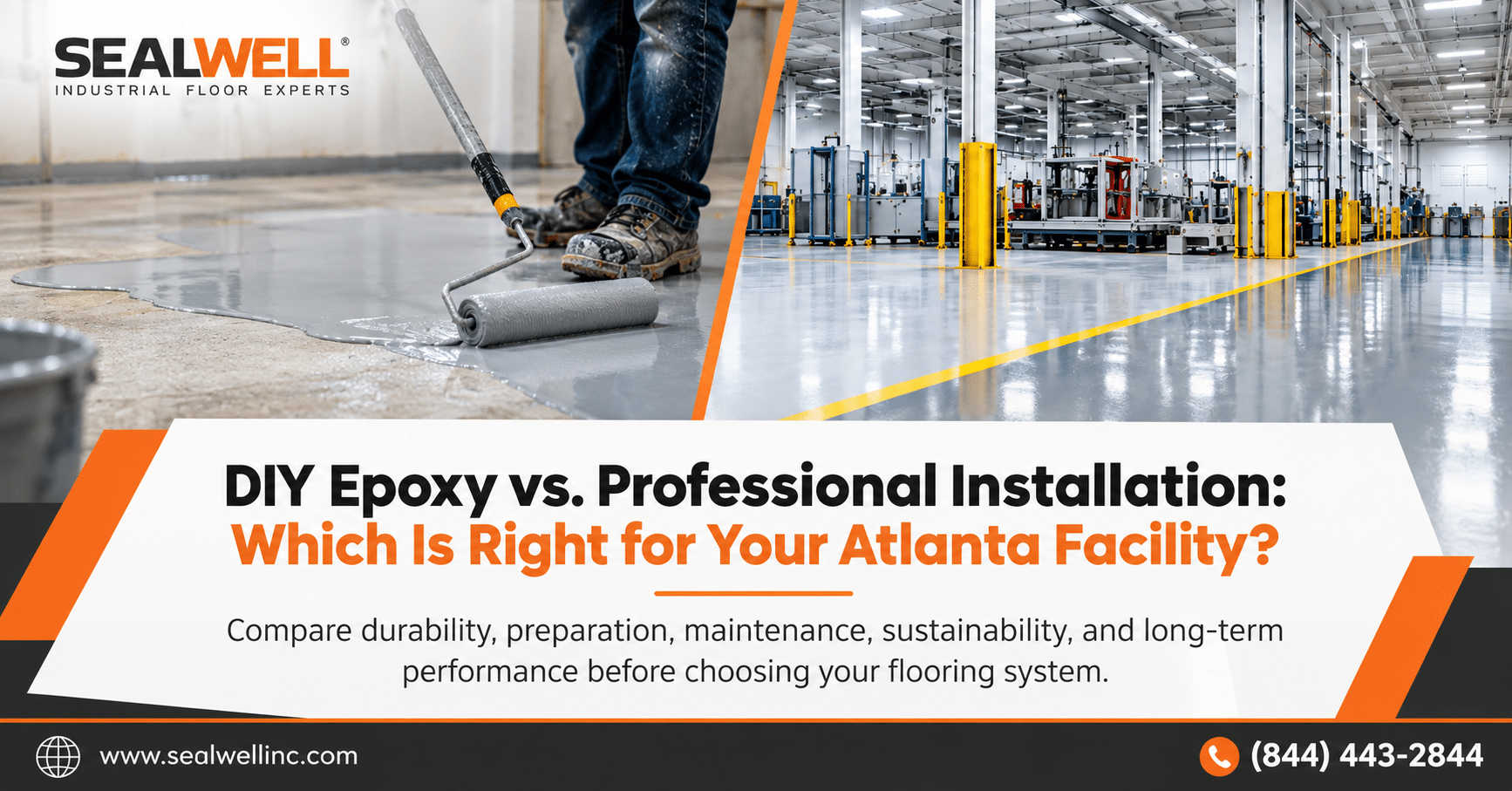
Choosing Epoxy Flooring in Atlanta involves more than deciding on a color or finish. For commercial, industrial, manufacturing, warehouse, retail, and other high-use facilities, the bigger question is whether a DIY epoxy system can meet operational demands or whether professional installation provides better long-term performance.
DIY epoxy products can appear attractive because of their lower upfront cost and relatively simple application instructions. However, commercial flooring performance depends heavily on concrete condition, surface preparation, moisture conditions, system selection, application quality, and curing.
A professionally installed flooring system can address these factors before installation begins, helping facility owners reduce premature failures, unnecessary repairs, and replacement needs.
This guide compares DIY epoxy with professional installation while also exploring polished concrete, low-VOC coatings, durable flooring systems, energy-efficient flooring considerations, and sustainable maintenance strategies.
Quick Answer: DIY Epoxy vs. Professional Epoxy Flooring
DIY epoxy can be suitable for small, light-duty spaces where traffic, chemicals, moisture, and operational demands are limited. Professional epoxy installation is generally more appropriate for commercial and industrial environments where durability, surface preparation, safety, downtime, and long-term performance matter.
Professional installation also gives facility managers access to flooring systems selected around actual site conditions rather than relying on a one-size-fits-all coating.
DIY vs. Professional Epoxy Flooring: Quick Comparison
|
Factor |
DIY Epoxy |
Professional Installation |
|
Initial Cost |
Generally lower |
Higher initial investment |
|
Concrete Evaluation |
Usually limited |
Professional floor inspection |
|
Surface Preparation |
Basic DIY preparation |
Mechanical preparation based on substrate conditions |
|
Moisture Assessment |
Often overlooked |
Can be evaluated before system selection |
|
Durability |
Better suited to lighter use |
Systems available for demanding commercial and industrial use |
|
Chemical Resistance |
Product dependent |
System selected around facility exposure |
|
Installation Quality |
Depends on installer experience |
Installed by trained flooring professionals |
|
Installation Quality |
Depends on installer experience |
Installed by trained flooring professionals |
|
Downtime Planning |
Managed by owner |
Installation can be coordinated around operations |
|
Repair Risk |
Higher if preparation or application is incorrect |
Reduced through proper preparation and system selection |
|
Low-VOC Options |
Available on some products |
Low-VOC systems can be specified based on project requirements |
|
Maintenance Planning |
Usually not included |
Maintenance requirements can be considered during system selection |
|
Long-Term Replacement Needs |
May increase with premature failure |
Durable systems can help extend service life |
|
Best Application |
Small/light-duty areas |
Commercial and industrial facilities |
What Is DIY Epoxy Flooring?
DIY epoxy flooring typically involves purchasing a prepackaged coating system and applying it directly to a prepared concrete surface.
The process may include cleaning the concrete, repairing visible cracks, preparing or etching the surface, mixing resin and hardener, applying the coating, adding decorative flakes if desired, and allowing the floor to cure.
The apparent simplicity can make DIY epoxy appealing.
However, applying a coating is only one part of a successful flooring project. The condition and preparation of the concrete beneath the coating can have a major impact on performance.
Where Can DIY Epoxy Make Sense?
DIY epoxy may be appropriate for smaller, low-demand spaces where the consequences of coating failure are limited.
Examples can include residential garages, utility rooms, hobby spaces, storage areas, or other light-duty applications.
A commercial or industrial facility presents a different challenge. Forklift traffic, heavy equipment, chemicals, thermal changes, moisture, abrasion, frequent cleaning, and continuous foot traffic can place considerably greater demands on a floor.
Why Surface Preparation Matters for Epoxy Flooring in Atlanta
For Epoxy Flooring in Atlanta, proper concrete preparation is one of the most important parts of the installation process.
Applying epoxy over contaminated, weak, damp, or improperly prepared concrete can contribute to adhesion problems, peeling, bubbling, or premature coating failure.
Professional flooring contractors can evaluate factors such as:
- Existing coatings and contaminants
- Concrete surface condition
- Cracks, joints, and damaged areas
- Moisture-related concerns
- Required surface profile
- Traffic and equipment loads
- Chemical exposure
- Cleaning and sanitation requirements
- Desired slip resistance
- Expected service life
Professional mechanical preparation methods may include grinding or shot blasting depending on the substrate and flooring system.
The objective is not simply to make concrete look clean. It is to create the appropriate surface profile and conditions for the selected flooring system to bond properly.
Professional Epoxy Installation Is a Flooring System, Not Just a Coating
One of the biggest differences between a DIY product and professional installation is the approach to the project.
A commercial floor may require a combination of substrate repairs, primers, resinous layers, broadcast aggregates, protective topcoats, coving, slip-resistant textures, or other system components.
The right solution depends on the facility.
A warehouse may prioritize abrasion and impact resistance. A food-processing environment may need seamless surfaces and cleaning performance. Manufacturing facilities may need chemical-resistant systems, while electronics-related operations may require specialized static-control flooring.
Professional installation allows the flooring system to be designed around those requirements.
How Durable Is Professional Epoxy Flooring?
There is no single lifespan for every epoxy floor because performance depends on the system, concrete condition, installation quality, traffic, chemicals, cleaning practices, and environmental conditions.
However, professionally specified commercial flooring systems are designed to address the demands of their intended environment.
A durable floor can help reduce:
- Premature coating failures
- Frequent repairs
- Unplanned operational disruption
- Recoating frequency
- Material consumption from repeated replacement
- Long-term maintenance demands
That makes durability important not only for operational performance but also for lifecycle sustainability.
Low-VOC Coatings and More Sustainable Flooring Decisions
Sustainability is becoming an increasingly important consideration for commercial facilities.
Low-VOC flooring technologies can help reduce the amount of volatile organic compounds associated with certain coating applications. The exact VOC characteristics depend on the specific product and system selected, so facility owners should review product documentation when environmental requirements are important.
But sustainable flooring decisions extend beyond VOC content.
A floor that lasts longer and requires fewer replacements can reduce the materials, transportation, labor, and waste associated with repeated flooring projects.
Professional evaluation can therefore focus on both immediate project requirements and long-term flooring performance.
Could Polished Concrete Be a Better Alternative?
Epoxy is not automatically the right choice for every concrete floor.
For some facilities, polished concrete may provide an effective alternative.
Polished concrete uses the existing concrete slab and mechanically processes the surface to produce a durable, refined finish. Depending on facility requirements, it can offer advantages such as relatively straightforward maintenance and reduced reliance on additional coating layers.
It may be considered for warehouses, retail spaces, commercial facilities, showrooms, distribution environments, and other areas where the substrate and operational requirements are appropriate.
The better question is therefore not simply:
“Should I use epoxy?”
It is:
“Which flooring system best matches my facility, concrete condition, traffic, environment, maintenance requirements, and performance goals?”
A professional floor inspection can help answer that question.
Can Flooring Contribute to Energy Efficiency?
Flooring should not be viewed as a substitute for a building’s primary energy-efficiency systems. However, flooring can play a supporting role in how a facility uses and distributes light.
Light-colored and reflective floor finishes can improve perceived brightness and light distribution in some indoor environments. The actual impact on lighting or energy consumption depends on the facility design, lighting system, reflectance values, and operating conditions.
For facilities pursuing broader sustainability goals, flooring can therefore be considered alongside lighting, HVAC, insulation, equipment efficiency, and building-envelope improvements.
Sustainable Maintenance Starts With the Right Floor
Sustainable maintenance is not simply about choosing environmentally preferable cleaning products. It also means selecting a floor that can withstand the facility’s actual cleaning and operating conditions.
An inappropriate flooring system may require repeated repairs, recoating, or premature replacement.
A properly specified system can help reduce unnecessary interventions over its service life.
Facility managers should consider:
- Cleaning frequency
- Cleaning chemicals
- Sanitization requirements
- Abrasive contaminants
- Wet conditions
- Equipment movement
- Expected traffic
- Repair accessibility
- Long-term recoating requirements
These factors should ideally be considered before installation rather than after flooring problems appear.
DIY Epoxy vs. Professional Installation: Which Should an Atlanta Business Choose?
The decision depends primarily on the space and its operational requirements.
DIY epoxy may make sense when the project is small, the environment is light duty, the concrete is in good condition, and the owner has the appropriate preparation and application experience.
Professional installation is worth considering when a facility has demanding traffic, operational downtime concerns, chemical exposure, moisture issues, damaged concrete, sanitation requirements, specialized performance needs, or a goal of maximizing service life.
For commercial and industrial properties, the upfront flooring price should therefore be considered alongside lifecycle factors such as repairs, maintenance, downtime, and replacement.
What Can Go Wrong With DIY Epoxy?
Common problems can include:
- Peeling or delamination
- Uneven coating thickness
- Visible roller marks
- Bubbles or pinholes
- Poor adhesion
- Improper curing
- Trapped contamination
- Inadequately repaired cracks
- Incorrect mixing ratios
- Insufficient surface preparation
These problems can become more costly when a failed coating must be removed before another system can be installed.
That is why evaluating the existing concrete first can be valuable.
Choosing a Flooring System for an Atlanta Facility
Before selecting a flooring system, facility managers should answer several practical questions.
What kind of traffic will the floor experience?
Consider employees, customers, carts, pallet jacks, forklifts, machinery, and vehicles.
Will the floor encounter chemicals?
Identify oils, cleaners, solvents, acids, food products, or process chemicals that may contact the surface.
Is moisture a concern?
Moisture conditions can affect coating selection and installation.
How much downtime is available?
Installation and cure schedules should align with operational requirements.
What are the maintenance expectations?
The flooring system should support realistic cleaning and maintenance procedures.
How important are appearance and light reflectivity?
Color, gloss, texture, and finish can affect both aesthetics and the working environment.
Answering these questions before choosing a product can prevent the common mistake of selecting flooring based only on upfront price.
Frequently Asked Questions (FAQs)
Is professional epoxy flooring better than DIY epoxy?
For demanding commercial and industrial environments, professional installation provides advantages such as professional substrate evaluation, mechanical surface preparation, system selection, repairs, and controlled application. DIY systems can still be appropriate for smaller, light-duty applications.
Is DIY epoxy cheaper than professional installation?
DIY epoxy generally has a lower initial material and installation cost. However, facility owners should also consider preparation equipment, labor, repairs, downtime, maintenance, and the potential cost of removing and replacing a failed coating.
How long does epoxy flooring last?
There is no universal lifespan. Epoxy flooring performance depends on the flooring system, substrate preparation, traffic, chemical exposure, environmental conditions, maintenance, and installation quality. Professional specification can help match the system to the expected service conditions.
What is the biggest reason epoxy floors fail?
Inadequate surface preparation is a common contributor to coating problems. Moisture, contamination, incorrect application, improper mixing, substrate movement, and selecting an unsuitable system can also contribute to failure.
Is polished concrete better than epoxy flooring?
Neither option is universally better. Polished concrete can work well where the existing slab and operating conditions are suitable, while epoxy and other resinous systems can provide properties such as chemical resistance, seamless finishes, color options, and specialized textures. The appropriate choice depends on the facility.
Are low-VOC epoxy coatings available?
Yes. Low-VOC coating technologies are available, although VOC content varies by product and flooring system. Product technical documentation should be reviewed when a project has specific environmental or indoor-air requirements.
Can epoxy flooring reduce maintenance costs?
A properly selected and installed flooring system can help reduce repair and replacement needs. Actual maintenance costs depend on traffic, cleaning practices, chemicals, facility conditions, and the system installed.
Does epoxy flooring improve energy efficiency?
Flooring alone does not determine a building’s energy efficiency. However, lighter and more reflective floor finishes can contribute to interior light distribution. Any energy savings depend on the complete lighting and building system.
Should I repair concrete before installing epoxy?
Concrete defects should be evaluated before coating installation. Cracks, spalls, damaged joints, contamination, and other substrate problems may require treatment before a flooring system is applied.
How do I choose the right commercial flooring system?
Start by evaluating the concrete substrate, traffic, chemicals, moisture conditions, cleaning requirements, slip resistance, appearance, available downtime, and expected service life. A professional floor inspection can help identify which flooring system best matches those conditions.
Who installs commercial epoxy flooring in Atlanta?
Sealwell provides commercial and industrial flooring solutions and can evaluate facility conditions before recommending an appropriate flooring system. Businesses considering Epoxy Flooring in Atlanta can connect with the Sealwell team to arrange a site visit and floor inspection and discuss a durable, maintainable flooring solution for their facility.
Why Sealwell Team Experts?
Choosing the right flooring system begins with understanding the condition of the floor and how the facility operates.
Sealwell works with commercial and industrial facilities to evaluate flooring requirements and identify systems appropriate for the environment. Depending on project needs, solutions may include epoxy and polyurethane flooring, polished concrete, concrete treatments, specialized resinous systems, and other commercial flooring options.
Instead of starting with a one-size-fits-all product, the process should begin with the substrate, facility demands, and desired performance.
Planning a Flooring Project in Atlanta?
Connect with the Sealwell team to schedule a facility visit and professional floor inspection.
Talk to a Sealwell Flooring Expert
Planning a flooring project in Atlanta? Fill out the form on this page to connect with a Sealwell flooring expert, schedule a site visit, and discuss the right flooring system for your facility.
Our trusted clients: