Blog and News
The Role of Flooring in Food Safety: What Food Manufacturing Plants Need to Know
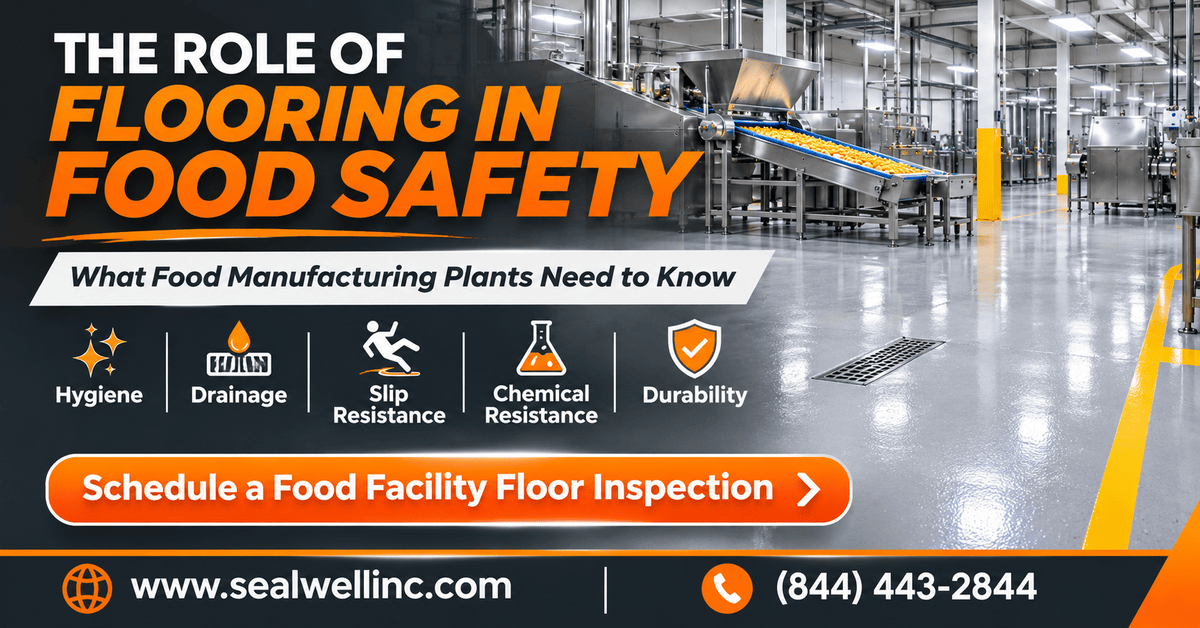
Choosing the right Food & Beverage Flooring Florida solution is about much more than durability and appearance. For food manufacturers, beverage processing facilities, commercial production plants, and packaging operations, flooring plays an important role in sanitation, contamination prevention, employee safety, and operational efficiency. From food processing facilities in Orlando and Jacksonville to beverage manufacturing plants throughout Florida, the right flooring system can help create a cleaner, safer, and more efficient production environment.
Food manufacturing plants operate under demanding conditions. Floors are exposed to moisture, oils, food ingredients, cleaning chemicals, temperature changes, heavy machinery, and constant traffic. When flooring deteriorates, cracks, damaged joints, and uneven surfaces can create areas where residue accumulates and cleaning becomes difficult.
Facility managers must therefore consider flooring an important part of their overall food safety and preventive maintenance strategy.
This guide explores how industrial flooring affects food safety, which flooring systems are suitable for food processing environments, and what Florida food manufacturers should evaluate before installing, repairing, or resurfacing their floors.
Quick Answer: Why Is Flooring Important for Food Safety?
Food manufacturing flooring supports food safety by providing durable, cleanable surfaces that help facilities control contamination risks, manage moisture, maintain sanitation procedures, and support safe employee movement.
A properly selected flooring system can contribute to:
- Easier cleaning and sanitation
- Reduced accumulation of food residue
- Effective drainage and moisture management
- Resistance to appropriate cleaning chemicals
- Safer movement in wet processing areas
- Reduced surface deterioration
- Improved maintenance efficiency
- Support for applicable food safety requirements
However, no flooring system alone guarantees a food-safe facility.
Food safety also depends on sanitation procedures, equipment design, employee practices, environmental monitoring, and preventive controls.
- How Can Damaged Flooring Affect Food Manufacturing Safety?
Food manufacturing environments require regular cleaning and effective control of contamination sources.
When flooring begins to deteriorate, several problems can develop.
Cracks and Surface Damage
Concrete cracks, damaged coatings, and deteriorated joints may collect moisture, food particles, grease, and other residues.
These areas can become difficult to clean thoroughly.
If defects are not repaired, repeated washdowns and equipment traffic may contribute to further deterioration.
Standing Water and Moisture Accumulation
Water accumulation can interfere with sanitation and create slip hazards.
Improper drainage may also allow contaminated water to move between production areas.
Deteriorated Floor Coatings
Peeling coatings and damaged surfaces can make cleaning more difficult and expose underlying concrete to moisture and chemicals.
Uneven Surfaces
Surface irregularities can interfere with carts, forklifts, cleaning equipment, and employee movement.
Damaged Floor-to-Wall Transitions
Poorly maintained wall junctions may create hard-to-clean areas where food residue and moisture accumulate.
The key takeaway: Flooring damage is not simply a maintenance concern. In food manufacturing environments, it can affect sanitation effectiveness and operational safety.
- Seven Essential Features of Food-Safe Industrial Flooring
Not every industrial flooring system is suitable for food manufacturing.
The best solution depends on the processing activity, sanitation requirements, operating temperatures, traffic loads, and chemical exposure.
- Cleanable, Seamless Surfaces
Seamless resinous flooring systems can reduce the number of conventional grout joints and finish-material seams.
This can make routine cleaning more manageable.
However, concrete movement joints, drains, equipment penetrations, and other transitions still require appropriate detailing.
- Moisture Resistance
Food and beverage facilities frequently experience wet conditions from production, cleaning, condensation, and spills.
The flooring system should be selected for the expected moisture exposure and substrate conditions.
- Chemical Resistance
Cleaning chemicals, food acids, oils, fats, and sanitizing agents can affect flooring materials.
Chemical resistance should be evaluated using the selected product’s technical specifications.
- Appropriate Slip Resistance
Wet and greasy floors can create traction problems.
Flooring texture should be selected based on expected contaminants, footwear, cleaning methods, and operational conditions.
- Thermal Shock Resistance
Food manufacturing floors may experience rapid temperature changes from hot-water cleaning, production processes, or refrigerated environments.
Appropriately specified flooring systems can help accommodate these demands.
- Heavy-Duty Durability
Forklifts, pallet jacks, production machinery, and continuous traffic can contribute to flooring wear.
Durability requirements should reflect actual equipment loads and operating conditions.
- Effective Drainage and Cove Bases
Properly designed drainage helps prevent standing water.
Integrated cove bases can improve cleanability at wall-to-floor junctions.
These features are especially important in wet processing and washdown environments.
- Which Flooring Systems Are Best for Food Manufacturing Plants?
Food processing facilities often contain several different operating zones.
A single flooring system may not be suitable for every area.
Urethane Cement Flooring
Urethane cement, also called cementitious urethane or polyurethane cement, is commonly considered for demanding food processing environments.
Appropriately specified systems can provide resistance to moisture, thermal shock, impact, and various chemicals.
Potential applications include:
- Meat and poultry processing areas
- Dairy production facilities
- Beverage manufacturing plants
- Commercial food preparation areas
- Wet processing environments
- Industrial washdown areas
Epoxy Flooring
Epoxy flooring can provide durable, seamless surfaces with product-specific chemical resistance.
It may be suitable for packaging areas, dry production spaces, storage facilities, and other environments where severe thermal cycling is not expected.
Polyurethane Flooring
Selected polyurethane systems may provide useful abrasion, chemical, or flexibility characteristics.
Their suitability depends on the specific formulation and operating environment.
Polished Concrete
Polished concrete can be considered for suitable dry storage, distribution, and lower-exposure areas.
However, it is generally not the first choice for continuously wet processing zones requiring frequent aggressive sanitation.
Commercial Tile Flooring
Commercial tile can perform well when the complete tile assembly is appropriate for the facility.
Grout, joints, and damaged sections require particular attention during cleaning and maintenance.
- Food Manufacturing Flooring Comparison: Which System Should You Choose?
|
Flooring Feature |
Urethane Cement |
Epoxy Flooring |
Polished Concrete |
Commercial Tile |
|
Seamless Finish |
Yes, with required joints and details |
Yes, with required joints and details |
Continuous concrete surface with joints |
No; grout joints present |
|
Moisture Resistance |
Strong in suitable systems |
Product-dependent |
Limited for demanding wet processing |
Depends on tile assembly |
|
Chemical Resistance |
Strong for many processing chemicals |
Strong with suitable formulation |
Limited without suitable protection |
Depends on tile and grout |
|
Thermal Shock Resistance |
Often suitable for demanding applications |
Product-dependent |
Depends on concrete condition |
Assembly-dependent |
|
Slip-Resistant Texture |
Available |
Available |
Finish-dependent |
Tile-dependent |
|
Heavy Traffic Performance |
Strong when specified correctly |
Strong when specified correctly |
Strong on suitable slabs |
Strong with suitable assembly |
|
Cleaning Requirements |
Generally manageable |
Generally manageable |
Depends on exposure and finish |
Grout requires attention |
|
Typical Applications |
Wet processing and washdowns |
Dry production and packaging |
Dry storage and distribution |
Selected production and service areas |
What Is the Best Flooring for Food Processing Facilities?
Urethane cement is often a strong candidate for wet food processing areas exposed to frequent washdowns, temperature changes, and heavy traffic. Epoxy may be suitable for dry processing and packaging areas, while polished concrete may be appropriate for certain storage and distribution spaces.
The correct choice requires evaluating each production zone rather than selecting one material for the entire facility.
- How Does Flooring Help Prevent Contamination in Food Processing Plants?
Food safety depends on controlling contamination throughout the production environment.
Floors are not usually direct food-contact surfaces, but their condition can influence sanitation and the movement of contaminants.
Minimizing Hard-to-Clean Areas
A well-maintained flooring system reduces cracks, damaged surfaces, and unnecessary finish-material joints that can complicate cleaning.
Supporting Effective Cleaning Procedures
Flooring should withstand the cleaning products and methods required by the facility.
Surface texture should also allow effective soil removal.
Managing Water Movement
Proper drainage can help prevent water from accumulating or spreading into other production areas.
Maintaining Surface Integrity
Routine inspections and timely repairs help prevent localized damage from developing into more extensive flooring problems.
Supporting Hygienic Facility Design
Floor-to-wall coving, suitable drain details, and well-maintained penetrations can make sanitation procedures more effective.
Importantly, seamless flooring is not inherently antimicrobial. Contamination control still depends on correct cleaning, sanitizing, environmental monitoring, and facility management.
- What Are the FDA and USDA Flooring Requirements for Food Manufacturing Plants?
Food manufacturers should evaluate flooring as part of their broader regulatory and sanitation responsibilities.
Under the FDA’s Current Good Manufacturing Practice requirements in 21 CFR Part 117, facilities must be designed and maintained to support sanitary operations.
The regulations also address adequate drainage where floors are exposed to flooding-type cleaning or where normal operations release liquid waste.
For applicable USDA-FSIS-regulated meat and poultry establishments, sanitation performance standards address the construction, maintenance, cleaning, and sanitation of floors, walls, and ceilings.
Important Flooring Considerations
- Maintain floors in suitable condition.
- Prevent flooring damage from contributing to unsanitary conditions.
- Provide adequate drainage where required.
- Use materials appropriate for the operating environment.
- Maintain surfaces so they can be cleaned effectively.
- Repair defects that interfere with sanitation.
- Follow applicable facility-specific regulatory requirements.
Does Installing Epoxy or Urethane Cement Automatically Make a Plant FDA-Compliant?
No.
A particular flooring product does not automatically establish FDA or USDA compliance.
Compliance depends on the complete facility, the applicable regulations, sanitation programs, processing activities, and how the flooring system is installed and maintained.
Facility managers should coordinate flooring specifications with their food safety and quality assurance teams.
- Why Is Flooring Especially Important for Florida Food and Beverage Facilities?
Florida’s food and beverage industry includes manufacturing, processing, packaging, refrigerated storage, and distribution operations.
These facilities may experience different environmental and operational conditions.
Humidity and Moisture Management
Florida’s humid climate makes moisture management an important consideration.
However, flooring problems depend on the actual building conditions, concrete substrate, vapor transmission, drainage, cleaning practices, and temperature control.
Refrigerated and Temperature-Controlled Areas
Facilities operating cold rooms or refrigerated processing spaces may experience condensation and temperature transitions.
Flooring systems should be rated for the expected environmental conditions.
Wet Processing Operations
Beverage production, seafood processing, produce washing, and other wet operations may require flooring designed for frequent liquid exposure and sanitation.
High-Traffic Production Facilities
Manufacturing plants and distribution areas experience regular equipment movement.
Flooring must accommodate the facility’s traffic and impact requirements.
Maintenance and Operational Scheduling
Production schedules can make flooring repairs challenging.
A planned maintenance program can help facility managers identify problems early and coordinate repairs around operational requirements.
- How Do Proper Drainage and Cove Bases Improve Food Plant Hygiene?
Drainage and wall-to-floor transitions are important elements of hygienic flooring design.
Proper Floor Drainage
In areas exposed to regular washdowns, floors should be designed to direct water toward appropriate drains.
Standing water may interfere with cleaning and create unsafe walking conditions.
The correct floor slope and drain configuration depend on the facility design and applicable requirements.
Integrated Cove Bases
Cove bases create a more cleanable transition between the floor and wall.
They can reduce hard-to-reach corners where residue may accumulate.
Drain and Equipment Penetration Details
Floor drains, machinery supports, and pipe penetrations require careful installation and maintenance.
Poorly detailed transitions may allow moisture intrusion or create cleaning challenges.
A complete flooring evaluation should include these details, not just the visible floor surface.
- What Are the Most Common Flooring Problems in Food Manufacturing Plants?
Food processing environments can experience several recurring flooring issues.
|
Flooring Problem |
Potential Cause |
Recommended Next Step |
|
Concrete Cracks |
Movement, impact, loading, or deterioration |
Evaluate the cause and repair suitability |
|
Peeling Coatings |
Moisture, contamination, preparation, or system mismatch |
Inspect substrate and coating adhesion |
|
Standing Water |
Drainage problems or low areas |
Evaluate slope and drainage |
|
Chemical Damage |
Incompatible chemicals or prolonged exposure |
Review chemical resistance requirements |
|
Worn Traffic Lanes |
Repeated equipment and foot traffic |
Consider repairs or resurfacing |
|
Damaged Cove Bases |
Impact, movement, or deterioration |
Repair or replace affected details |
|
Slippery Surfaces |
Water, grease, residue, or unsuitable texture |
Review cleaning and traction requirements |
|
Surface Spalling |
Impact, moisture, or concrete deterioration |
Assess substrate condition and repair |
Addressing these problems early may reduce the extent of future flooring work.
- How Often Should Food Manufacturing Floors Be Inspected?
There is no single inspection frequency suitable for every food manufacturing facility.
The schedule should reflect production activities, flooring materials, chemical exposure, moisture conditions, equipment traffic, and the facility’s food safety program.
Daily Visual Checks
Employees can identify spills, standing water, damaged surfaces, and obvious safety concerns during routine operations.
Scheduled Maintenance Inspections
Facility maintenance teams should monitor joints, cracks, drains, cove bases, and areas experiencing heavy wear.
Periodic Professional Flooring Inspections
Professional evaluations can help identify deterioration that may require specialized repairs, resurfacing, or replacement.
After Operational Changes
Floors should be reevaluated when facilities introduce new machinery, chemicals, cleaning procedures, or production processes that change flooring exposure.
Documenting inspection findings can help prioritize maintenance and future flooring investments.
- Food Manufacturing Floor Safety and Maintenance Checklist
Facility managers can use the following checklist as a starting point for routine flooring evaluations.
|
Inspection Item |
What to Check |
Recommended Action |
|
Surface Condition |
Cracks, spalling, coating wear |
Record and evaluate damage |
|
Drainage |
Standing water or blocked drains |
Investigate and correct the cause |
|
Slip Resistance |
Wet, greasy, or worn areas |
Review traction and cleaning |
|
Chemical Exposure |
Staining, softening, deterioration |
Verify system compatibility |
|
Cove Bases |
Cracks, gaps, damaged transitions |
Repair where necessary |
|
Floor Joints |
Deterioration or open joints |
Evaluate joint repair needs |
|
Equipment Areas |
Impact damage or uneven surfaces |
Assess localized repairs |
|
Cleaning Compatibility |
Surface damage after sanitation |
Review cleaning procedures |
|
Moisture Conditions |
Blistering or coating delamination |
Investigate substrate moisture |
|
Maintenance Records |
Repeated defects or overdue repairs |
Update the maintenance plan |
This checklist should complement—not replace—the facility’s established sanitation, safety, and regulatory inspection procedures.
- Repair, Resurface, or Replace: What Should Food Manufacturers Do?
Not every damaged industrial floor requires complete replacement.
The appropriate solution depends on the extent of damage and the condition of the underlying concrete.
When to Repair
Localized cracks, spalls, damaged joints, and isolated coating defects may be suitable for targeted repairs.
When to Resurface
Resurfacing may be appropriate when large areas show surface deterioration but the underlying concrete remains suitable.
When to Replace
Replacement may be necessary when extensive deterioration, unsuitable substrates, or repeated failures make restoration impractical.
Comparison: Repair vs. Resurface vs. Replace
|
Factor |
Floor Repair |
Floor Resurfacing |
Floor Replacement |
|
Best For |
Localized defects |
Widespread surface wear |
Extensive or unsuitable flooring |
|
Project Scope |
Specific damaged areas |
Larger floor sections |
Removal and installation of affected system |
|
Downtime |
Often limited for small repairs |
Depends on preparation and curing |
May require substantial planning |
|
Relative Investment |
Often lower for isolated damage |
Depends on system and area |
Often higher for extensive work |
|
Main Objective |
Restore damaged sections |
Renew an existing floor |
Install a suitable replacement system |
A professional inspection helps determine the most appropriate approach for food safety, operational requirements, and long-term cost.
- How Can Food Manufacturers Reduce Flooring Maintenance Downtime?
Unplanned flooring repairs can interfere with production schedules, sanitation activities, and equipment movement.
Facility managers can reduce disruption through proactive planning.
Schedule Repairs Around Production
Coordinate flooring work with maintenance shutdowns, sanitation windows, or other available periods.
Consider Phased Installation
Where practical, flooring projects may be divided into sections to maintain access to unaffected areas.
Evaluate Curing Requirements
Different flooring systems have different return-to-service timelines.
The selected material must reach the manufacturer’s required curing conditions before normal operations resume.
Address Small Defects Early
Localized repairs may help prevent some forms of deterioration from spreading.
Maintain Inspection Records
Documenting recurring problems can help identify areas requiring more extensive corrective work.
Coordinate With Food Safety Teams
Repair activities should be planned to control dust, debris, chemical exposure, and other potential contamination risks.
Production areas should only be reopened after required cleaning, inspection, and release procedures are completed.
Why Choose Sealwell Team Experts for Food and Beverage Flooring?
Food manufacturing flooring requires an understanding of sanitation requirements, concrete conditions, moisture exposure, heavy traffic, chemical resistance, and operational scheduling.
Sealwell specializes in industrial and commercial flooring solutions, including epoxy flooring, polyurethane flooring, urethane cement systems, concrete repairs, resurfacing, inspections, and maintenance.
For Florida food and beverage facilities, the right flooring approach begins with understanding how each production area operates.
How Sealwell Can Help Your Facility
The Sealwell team can help evaluate:
- Existing concrete and coating conditions
- Cracks and damaged joints
- Moisture-related flooring concerns
- Chemical and cleaning exposure
- High-traffic production areas
- Drainage and floor transitions
- Flooring repair and resurfacing needs
- Suitable industrial flooring systems
- Maintenance planning
- Installation scheduling requirements
A professional site evaluation helps determine whether localized repairs, resurfacing, or a new flooring system is the appropriate next step.
Need a Professional Food Manufacturing Floor Inspection?
Damaged flooring, standing water, worn coatings, or deteriorated joints can create maintenance and sanitation challenges for your facility.
Connect with Sealwell’s flooring experts to discuss your existing floor conditions and operational requirements.
Frequently Asked Questions (FAQs)
What is the best flooring for food manufacturing plants?
Urethane cement and appropriately specified epoxy flooring are common options for food manufacturing facilities. Urethane cement is often preferred in demanding wet processing areas, while epoxy may be suitable for dry production and packaging environments.
Why is flooring important for food safety?
Flooring affects sanitation, drainage, contamination control, and employee safety. Cleanable, durable, well-maintained surfaces help food manufacturers manage these risks.
What flooring is best for wet food processing areas?
Appropriately specified urethane cement systems are often suitable for wet processing environments because of their resistance to moisture, thermal cycling, chemicals, and heavy traffic.
Is epoxy flooring suitable for food processing facilities?
Yes. Selected epoxy systems can be suitable for food processing and packaging areas. Performance depends on the formulation, substrate conditions, chemical exposure, and cleaning requirements.
What is hygienic flooring?
Hygienic flooring refers to flooring designed and maintained to support effective cleaning and sanitation. Important characteristics may include cleanability, moisture resistance, appropriate drainage, and durable surface construction.
Does FDA require epoxy flooring in food manufacturing plants?
No universal FDA requirement mandates epoxy flooring for every food manufacturing plant. Applicable regulations focus on sanitary conditions, suitable facility construction, and contamination prevention.
Is seamless flooring better for food manufacturing?
Seamless flooring can reduce conventional grout joints and finish-material seams, potentially simplifying cleaning. However, appropriate drainage, surface detailing, maintenance, and sanitation remain essential.
Can damaged concrete floors affect food safety?
Yes. Cracks, spalling, and damaged joints may create hard-to-clean areas and contribute to sanitation challenges. Damage should be evaluated and corrected appropriately.
Why is floor drainage important in food processing facilities?
Proper drainage helps remove water and liquid waste, reducing standing water and supporting sanitation procedures. Adequate drainage is also addressed in applicable food manufacturing regulations.
What is the difference between epoxy and urethane cement flooring?
Epoxy flooring is a resinous system suitable for many industrial applications. Urethane cement combines polyurethane-based materials with cementitious components and is often selected for more demanding thermal and wet processing conditions.
Can food manufacturing floors be slip-resistant and easy to clean?
Yes. Flooring systems can be specified with appropriate surface textures. The correct balance depends on contaminants, footwear, sanitation methods, and operational requirements.
How often should food manufacturing floors be inspected?
Inspection frequency depends on facility conditions and risk. Daily visual checks, scheduled maintenance inspections, and periodic professional evaluations can help identify deterioration.
Can food processing floors be repaired without shutting down the entire plant?
Some repairs can be completed in phases or during planned maintenance windows. The feasibility depends on the repair scope, safety requirements, sanitation controls, and curing conditions.
How long does industrial food processing flooring last?
Service life varies according to the flooring system, installation quality, traffic, chemicals, temperature exposure, and maintenance. No single lifespan applies to every food manufacturing environment.
What causes epoxy flooring to peel in food manufacturing plants?
Possible causes include moisture, inadequate surface preparation, contamination, unsuitable materials, application problems, and operating conditions beyond the system’s capabilities.
Can polished concrete be used in food manufacturing facilities?
Polished concrete may be suitable for certain dry storage and distribution areas. It may not be appropriate for wet processing zones with demanding sanitation or chemical exposure requirements.
How can food manufacturers reduce flooring maintenance costs?
Routine inspections, prompt repairs, suitable cleaning procedures, and preventive maintenance planning can help reduce unnecessary deterioration and improve budgeting.
What should I look for in a food processing flooring contractor?
Look for experience with industrial flooring, substrate evaluation, moisture management, surface preparation, chemical exposure, sanitation requirements, and project scheduling.
Does Sealwell provide food and beverage flooring services in Florida?
Sealwell provides industrial and commercial flooring solutions for Florida facilities, including repairs, resurfacing, epoxy flooring, polyurethane systems, inspections, and maintenance. Contact the team to discuss your specific project location and requirements.
How can I schedule a food manufacturing floor inspection with Sealwell?
Visit Sealwell’s website and complete the contact form with your facility location, flooring concerns, and project details. The team can discuss the next steps for a site visit and flooring evaluation.
Protect Food Safety With the Right Industrial Flooring Strategy
Food manufacturing floors must support sanitation, employee safety, operational efficiency, and long-term durability. From moisture resistance and drainage to chemical exposure and heavy equipment traffic, every flooring decision should reflect the facility’s actual processing requirements.
Choosing the right Food & Beverage Flooring Florida solution starts with understanding your existing floor conditions and selecting a system appropriate for your operations.
Whether your facility needs epoxy flooring, urethane cement, concrete repairs, resurfacing, or preventive maintenance, Sealwell can help you explore the available options.
Fill out the form on this page to connect with Sealwell’s flooring experts and schedule a professional facility visit, floor inspection, and maintenance consultation.
Our trusted clients: