Blog and News
Polished Concrete vs. Vinyl vs. Tile: Best Flooring for Laundromats?
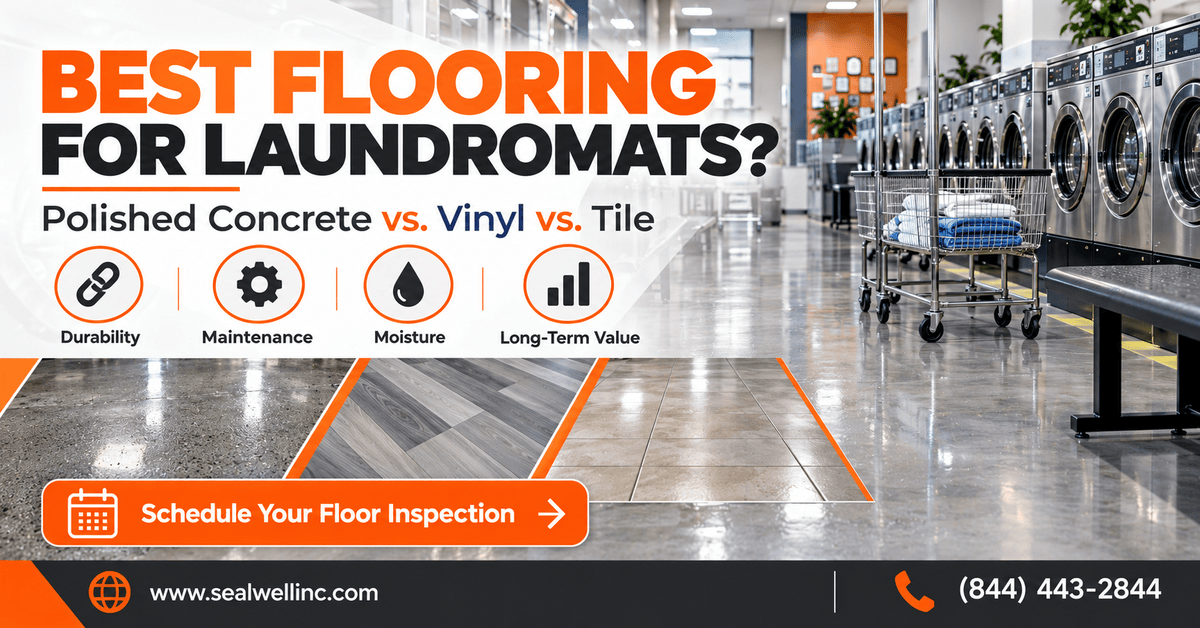
Choosing the right Laundromat Flooring is an important decision for owners and operators of public laundry facilities. Unlike ordinary retail spaces, laundromats experience continuous foot traffic, heavy washing equipment, detergent spills, water exposure, rolling laundry carts, and frequent cleaning. These conditions make flooring durability, maintenance requirements, and long-term operating costs essential considerations.
Three common flooring options are polished concrete, commercial vinyl, and ceramic or porcelain tile. Each offers distinct advantages, but the right choice depends on the facility’s environment, existing substrate, moisture conditions, and operating requirements.
For many laundromats, polished concrete can be an attractive alternative to vinyl and tile because it uses the existing concrete slab, eliminates conventional grout lines, and can withstand demanding foot and cart traffic when properly designed and maintained.
However, moisture exposure, chemical spills, and slip resistance must be evaluated before selecting any flooring system.
Quick Answer: What Is the Best Flooring for a Commercial Laundromat?
Polished concrete is often a strong choice for laundromat customer areas and high-traffic spaces with a suitable concrete slab. Commercial vinyl may offer comfort and design flexibility, while porcelain tile can be useful in wet areas when properly specified and installed.
The best option depends on traffic, water exposure, cleaning requirements, substrate condition, and long-term maintenance costs.
No flooring material is automatically the best choice for every part of a laundry facility.
Polished Concrete vs. Vinyl vs. Tile: Flooring Comparison
|
Flooring Feature |
Polished Concrete |
Commercial Vinyl |
Ceramic or Porcelain Tile |
|
Heavy Foot Traffic |
Strong performance when properly finished |
Depends on product wear layer |
Strong with suitable commercial-grade tile |
|
Rolling Laundry Carts |
Durable on a sound slab |
Can experience indentation or wear |
Durable, but grout and edges need attention |
|
Water Exposure |
Requires spill control and suitable protection |
Some products resist surface water; seams and substrate remain concerns |
Tile can resist water, but grout and underlying assembly matter |
|
Cleaning |
No conventional grout lines; routine cleaning required |
Generally straightforward with compatible products |
Grout requires additional attention |
|
Chemical Resistance |
Depends on concrete protection and chemical exposure |
Depends on vinyl formulation |
Depends on tile and grout specifications |
|
Slip Resistance |
Depends on finish, contaminants and maintenance |
Depends on selected product |
Depends on tile texture and surface conditions |
|
Design Options |
Industrial, modern, decorative finishes |
Wide range of colors and patterns |
Extensive styles, textures and sizes |
|
Installation Considerations |
Requires suitable concrete and mechanical polishing |
Requires substrate preparation and product-specific installation |
Requires substrate preparation, setting materials and grout |
|
Long-Term Maintenance |
Periodic cleaning and possible reconditioning |
Cleaning, repair and eventual replacement |
Cleaning, grout maintenance and possible tile repairs |
|
Best Application |
Suitable dry-to-intermittently-wet traffic areas |
Appropriate areas with controlled moisture exposure |
Selected wet or customer areas with proper detailing |
Key takeaway: Polished concrete may provide attractive long-term value where the existing slab is suitable, but water management and traction are critical. Vinyl and tile may be preferable in particular areas depending on exposure and performance requirements.
- Why Polished Concrete Is a Smart Choice for Public Laundromats
Public laundromats operate in demanding environments.
Customers regularly move between washers, dryers, folding tables, seating areas, and entrances. Laundry carts carry heavy loads across the floor, while detergents and water may occasionally spill.
A flooring system must support these activities without requiring constant repairs or excessive maintenance.
Polished concrete can offer several practical advantages.
Durable Performance Under Heavy Traffic
Polished concrete is created by mechanically grinding, honing, and polishing a suitable concrete slab.
Depending on the concrete condition and project requirements, densifiers and protective treatments may also be used.
Unlike some applied floor coverings, polished concrete does not rely on a separate vinyl wear layer or conventional tile-and-grout assembly.
This can make it a practical choice for facilities experiencing repeated foot traffic and rolling cart movement.
However, existing cracks, damaged joints, and weak concrete should be evaluated before polishing begins.
Fewer Seams and No Conventional Grout Lines
One of the main advantages of polished concrete is its relatively continuous surface.
Tile flooring contains grout joints that require cleaning and maintenance.
Vinyl flooring may contain seams, depending on the product and installation method.
Polished concrete eliminates these conventional finish-material joints, although existing concrete control and construction joints still require appropriate treatment.
Fewer finish-material seams can simplify routine cleaning in many customer-facing areas.
Modern Commercial Appearance
Polished concrete can create a clean, contemporary appearance that works well with modern laundromat interiors.
Depending on the existing slab, the finish can range from a subtle matte appearance to a higher-gloss surface.
The final appearance depends on the concrete’s aggregate, condition, color variations, and polishing process.
For laundromat owners updating an older facility, polished concrete may provide an attractive appearance without installing an entirely new decorative floor covering.
- Polished Concrete vs. Vinyl Flooring: Which Is Better for Laundromats?
Commercial vinyl is frequently considered for retail and service environments because of its design options, installation versatility, and cleaning characteristics.
However, different vinyl products perform differently.
Luxury vinyl tile, commercial sheet vinyl, and other resilient flooring products should not be treated as interchangeable.
Advantages of Commercial Vinyl
Commercial vinyl may offer:
- A broad selection of colors and patterns
- A more resilient feel underfoot
- Product-specific slip-resistant options
- Relatively straightforward routine cleaning
- Flexibility for interior design projects
Some commercial sheet vinyl systems can also be installed with welded seams and suitable detailing for moisture-sensitive applications.
Limitations of Vinyl in Public Laundry Facilities
Laundromats can expose vinyl flooring to rolling loads, equipment movement, cleaning chemicals, and recurring moisture.
Potential concerns include indentation, wear, damaged seams, and moisture reaching the substrate through poorly maintained details.
Performance depends heavily on the product selected and the installation.
Why Polished Concrete May Be a Better Choice
Where the concrete slab is suitable, polished concrete can avoid some of the wear-layer and seam concerns associated with vinyl.
It may also reduce the need for periodic replacement of a separate floor covering.
However, polished concrete is not waterproof and is not inherently resistant to all detergents or cleaning chemicals.
Best choice: Consider polished concrete for durable, high-traffic customer areas with manageable moisture exposure. Consider commercial vinyl where resilience, design flexibility, or a specifically engineered moisture-resistant flooring assembly is a higher priority.
- Polished Concrete vs. Tile: Which Performs Better?
Ceramic and porcelain tiles are common choices in commercial environments.
Properly specified porcelain tile can provide strong resistance to wear and water exposure.
Tile can be particularly useful where textured surfaces, drainage details, and suitable grout systems are important.
However, tiled floors introduce additional joints and installation components.
Advantages of Commercial Tile Flooring
- Wide range of surface textures
- Strong durability with suitable tile specifications
- Good surface water resistance for many porcelain products
- Extensive decorative options
- Individual tile replacement in some situations
Challenges of Tile Flooring in Laundromats
Tile installations may experience problems involving cracked tiles, damaged grout, loose sections, or deteriorating joints.
Heavy equipment movement and rolling carts can also place stress on unsuitable tile assemblies.
Grout lines may collect soil and detergent residue, increasing cleaning requirements.
Why Polished Concrete Can Offer Long-Term Value
Polished concrete does not require conventional tile grout.
This can reduce the number of finish-material joints that need regular attention.
When the existing slab is sound, polishing may also avoid the additional materials and installation steps associated with a tile assembly.
However, tile may be preferable in areas requiring a specially designed wet-floor system, drainage slopes, or particular surface textures.
Best choice: Polished concrete is worth considering for large, open laundromat areas. Properly specified tile may be more suitable in selected wet-service locations.
- Seven Reasons Laundromat Owners Consider Polished Concrete
- Suitable for Heavy Customer Traffic
Laundromats may operate for extended hours, with customers continuously entering, moving carts, and using machines.
A properly finished concrete surface can provide durable service in these high-use environments.
- No Conventional Tile Grout
Eliminating grout lines can simplify routine cleaning and reduce grout-related maintenance.
Concrete joints still require inspection and appropriate maintenance.
- Potential Long-Term Cost Advantages
When an existing slab can be polished successfully, owners may avoid installing a separate floor covering.
Lifecycle costs depend on the slab’s condition, polishing requirements, maintenance practices, and expected service life.
- Modern, Professional Appearance
Polished concrete can complement modern washers, dryers, folding stations, and commercial interior finishes.
A clean, consistent-looking floor may contribute to a more appealing customer environment.
- Compatible With Routine Maintenance Programs
Regular dust removal, prompt spill cleanup, and appropriate cleaning products can help preserve the finish.
Periodic reconditioning may be necessary depending on traffic and wear.
- Uses the Existing Concrete Slab
Where feasible, polishing an existing slab can reduce the need for additional floor-covering materials.
This may support renovation projects focused on efficient use of existing building materials.
- Flexible Finish Options
Polished concrete can be specified with different aggregate exposure levels and sheen levels.
The most appropriate finish should consider appearance, cleaning, traction, and facility conditions rather than gloss alone.
- Is Polished Concrete Slippery When Wet?
This is one of the most important questions laundromat owners should ask.
Polished concrete can become slippery when wet or contaminated, depending on its surface finish, the substances present, footwear, and cleaning conditions.
A glossy appearance alone does not establish whether a floor is safe or unsafe.
Slip resistance should be evaluated for the actual operating environment.
Laundromats should consider:
- Water tracked from entrances
- Leaks around washing machines
- Detergent spills
- Fabric softener residue
- Cleaning chemicals
- Wet footwear
- Floor drainage
- Cleaning frequency
Where standing water or recurring detergent contamination is expected, a textured resinous flooring system or another appropriately specified surface may be more suitable.
How Can Laundromat Owners Improve Floor Safety?
Prompt spill cleanup, leak prevention, entrance matting, appropriate drainage, regular cleaning, and suitable floor selection can help manage slip risks.
A flooring professional can evaluate the conditions and recommend appropriate traction and surface characteristics.
- Can Polished Concrete Handle Water and Detergent Spills?
Polished concrete can tolerate routine cleaning and incidental moisture when properly maintained, but it should not be described as waterproof or completely chemical-resistant.
Concrete is porous, and polishing alone does not make the slab impermeable.
Certain detergents, acidic cleaners, concentrated chemicals, and prolonged liquid exposure may stain, etch, or otherwise affect the surface or its protective treatment.
What About Areas Around Washing Machines?
Areas with frequent leaks, persistent wet conditions, or regular chemical exposure may need a different flooring approach.
For these locations, a properly specified resinous flooring system, suitable tile assembly, or another moisture-resistant solution may provide better performance.
The best strategy may involve using different flooring systems in different parts of the laundromat.
- Which Flooring Is Most Cost-Effective Over Time?
The cheapest initial installation is not always the lowest-cost option over the life of a commercial property.
Laundromat owners should consider the complete flooring lifecycle.
Initial Installation Costs
The cost of polished concrete depends on the existing slab, repairs, surface condition, desired finish, and required preparation.
Vinyl and tile costs depend on material quality, substrate preparation, installation details, and labor.
Ongoing Maintenance
Polished concrete generally requires routine cleaning and periodic evaluation.
Vinyl may require repair or replacement of worn sections.
Tile may require grout cleaning, joint maintenance, and occasional tile replacement.
Repair and Replacement Costs
A floor that experiences repeated damage can create expenses beyond the direct cost of materials.
Owners should consider labor, business disruption, customer access, and maintenance frequency.
Lifecycle Cost Comparison
|
Cost Consideration |
Polished Concrete |
Commercial Vinyl |
Tile |
|
Initial Cost |
Depends heavily on existing slab |
Varies by product and preparation |
Varies by tile, grout and installation |
|
Routine Cleaning |
Generally straightforward |
Generally straightforward |
Grout may require extra attention |
|
Periodic Maintenance |
Possible reconditioning and joint repairs |
Wear-layer, seam or section repairs |
Grout and tile repairs |
|
Replacement Considerations |
Existing slab may be reconditioned if suitable |
Floor covering may need replacement |
Damaged sections or assemblies may need replacement |
|
Business Disruption |
Depends on polishing and repair scope |
Depends on removal and installation |
Depends on removal, setting and curing |
|
Long-Term Value |
Strong potential with suitable concrete |
Depends on product performance |
Strong potential with proper specification |
The most economical flooring choice is the one that meets the facility’s performance needs with an acceptable total cost over time.
- When Is Polished Concrete Not the Best Choice?
Although polished concrete has several advantages, it is not appropriate for every laundry facility.
Alternative flooring systems should be considered when:
- The existing concrete slab is severely deteriorated
- Persistent standing water is expected
- The area requires a specifically engineered waterproof assembly
- Concentrated chemical exposure is frequent
- The facility requires a particular traction profile
- Significant substrate moisture or contamination needs correction
- Equipment vibration or structural movement creates additional concerns
In these situations, a professional evaluation may identify a more appropriate solution.
A combination of flooring systems may provide better performance than using one material throughout the entire building.
- How Should Laundromat Owners Maintain Polished Concrete Floors?
Even durable commercial floors need regular maintenance.
A consistent cleaning program helps preserve appearance, reduce abrasive debris, and identify damage early.
Daily Maintenance
Remove dirt and debris, clean spills promptly, and inspect areas around washers and entrances for moisture.
Weekly Maintenance
Review high-traffic areas, inspect visible joints, and check for stains or changes in surface appearance.
Periodic Maintenance
Evaluate surface wear, review cleaning procedures, and determine whether professional reconditioning or repairs are needed.
Cleaning products should be compatible with the polished concrete system and any protective treatments.
Avoid assuming that aggressive or highly acidic cleaners are suitable for every concrete finish.
- How Do You Choose the Right Flooring for a New or Existing Laundromat?
Before selecting a flooring material, laundromat owners should evaluate the building and its operating conditions.
A professional assessment can help answer several important questions.
Is the existing concrete suitable for polishing?
Cracks, contamination, moisture, surface damage, and slab condition can influence the available options.
Where does water exposure occur?
Customer walkways may have different requirements from machine rooms or washdown areas.
What equipment loads will the floor experience?
Washing machines, dryers, rolling carts, and maintenance equipment should be considered.
What level of cleaning is required?
The flooring system should be compatible with the facility’s cleaning products and procedures.
How much downtime is available?
Renovation work may need to be completed around operating hours or scheduled closures.
What is the long-term maintenance budget?
The best decision should consider initial installation, expected upkeep, and future repair requirements.
Answering these questions helps facility owners choose flooring based on actual operating needs rather than appearance alone.
Why Choose Sealwell Team Experts for Commercial Laundry Flooring?
Choosing the right flooring system for a laundromat requires an understanding of concrete conditions, traffic demands, moisture exposure, cleaning procedures, and long-term maintenance.
Sealwell specializes in commercial and industrial flooring solutions, including polished concrete, epoxy flooring, polyurethane systems, concrete repairs, resurfacing, and maintenance.
Rather than recommending one flooring material for every environment, the appropriate approach begins with evaluating the facility.
Sealwell can help laundromat owners and facility managers explore:
- Existing concrete condition
- Suitability for polishing
- Cracks and joint repairs
- Moisture-related concerns
- Traffic and equipment requirements
- Flooring system selection
- Surface restoration options
- Ongoing floor maintenance needs
Frequently Asked Questions (FAQs)
What is the best flooring for a laundromat?
Polished concrete, commercial vinyl, and porcelain tile can all be suitable depending on the facility. Polished concrete is often worth considering for high-traffic customer areas with a sound concrete slab, while specially designed flooring systems may be preferable in persistently wet locations.
Is polished concrete better than vinyl for laundromats?
Polished concrete may offer advantages in durability, maintenance, and long-term value when the existing slab is suitable. Vinyl can provide greater resilience and design flexibility. The better choice depends on moisture exposure, traffic, installation requirements, and lifecycle costs.
Is polished concrete better than tile for commercial laundry facilities?
Polished concrete eliminates conventional grout lines and may simplify cleaning. Tile can offer strong water resistance and textured surface options when correctly specified. Each system has advantages depending on the application.
Is polished concrete slippery when wet?
It can be. Slip resistance depends on surface finish, contaminants, cleaning conditions, and footwear. Areas exposed to frequent water or detergent spills should be evaluated carefully before polished concrete is selected.
Can polished concrete withstand detergent spills?
Polished concrete may tolerate incidental spills when they are cleaned promptly, but some detergents and concentrated chemicals can damage or stain the surface. Chemical compatibility and protective treatments should be evaluated.
Is polished concrete waterproof?
No. Polished concrete is not inherently waterproof. Concrete can absorb moisture, and polishing does not create a fully waterproof flooring assembly.
Is vinyl flooring suitable for commercial laundromats?
Yes, certain commercial vinyl products can be suitable when properly specified and installed. Product selection, seam detailing, moisture conditions, traffic, and cleaning requirements are important considerations.
Is porcelain tile a good choice for laundromats?
Porcelain tile can be suitable for commercial laundry environments when the tile, grout, setting materials, substrate, and slip-resistant characteristics are selected for the intended conditions.
Which laundromat flooring is easiest to clean?
Polished concrete and commercial vinyl can be relatively straightforward to clean. Tile may require additional grout maintenance. Actual cleaning requirements depend on surface texture, contaminants, and maintenance procedures.
Does polished concrete require regular maintenance?
Yes. Routine cleaning, prompt spill removal, joint inspections, and periodic surface evaluations help maintain polished concrete. Reconditioning may be needed as the floor experiences wear.
How long does polished concrete flooring last?
Service life varies based on the quality and condition of the concrete, traffic, chemical exposure, installation, and maintenance. A suitable polished concrete floor can provide long-term service, but no single lifespan applies to every facility.
Is polished concrete cheaper than vinyl or tile?
Not always. Installation costs depend on the existing slab, required repairs, material specifications, and project size. Polished concrete may provide lifecycle savings when the slab is suitable and ongoing maintenance needs are manageable.
Can an existing laundromat concrete floor be polished?
In many cases, yes. However, the slab should first be evaluated for cracks, contamination, moisture, previous coatings, and other conditions that may affect the finished result.
What flooring is best around commercial washing machines?
The best system depends on the frequency of leaks, water exposure, chemical spills, equipment loads, and drainage requirements. Areas that remain wet may require a specially designed moisture-resistant or resinous flooring system rather than conventional polished concrete.
How can I get a laundromat flooring inspection?
Contact a commercial flooring contractor who can assess the existing substrate, operating conditions, and flooring requirements. Sealwell can discuss polished concrete and other commercial flooring solutions through its website contact form.
Choose the Right Flooring for Your Laundromat’s Long-Term Performance
Selecting the best Laundromat Flooring requires balancing durability, moisture exposure, cleaning requirements, appearance, installation costs, and long-term maintenance. Polished concrete can be a strong option for many public laundromats, particularly in high-traffic areas with a suitable concrete slab, but vinyl, tile, or specialized resinous flooring may be better suited to certain conditions.
Planning a new laundry facility or upgrading an existing floor? Fill out the form on this page to connect with Sealwell’s flooring experts and schedule a professional facility visit, floor inspection, and maintenance consultation.
Our trusted clients: