
Blog and News
Polished Concrete vs Epoxy Flooring: Which Is Better for Atlanta Facilities?
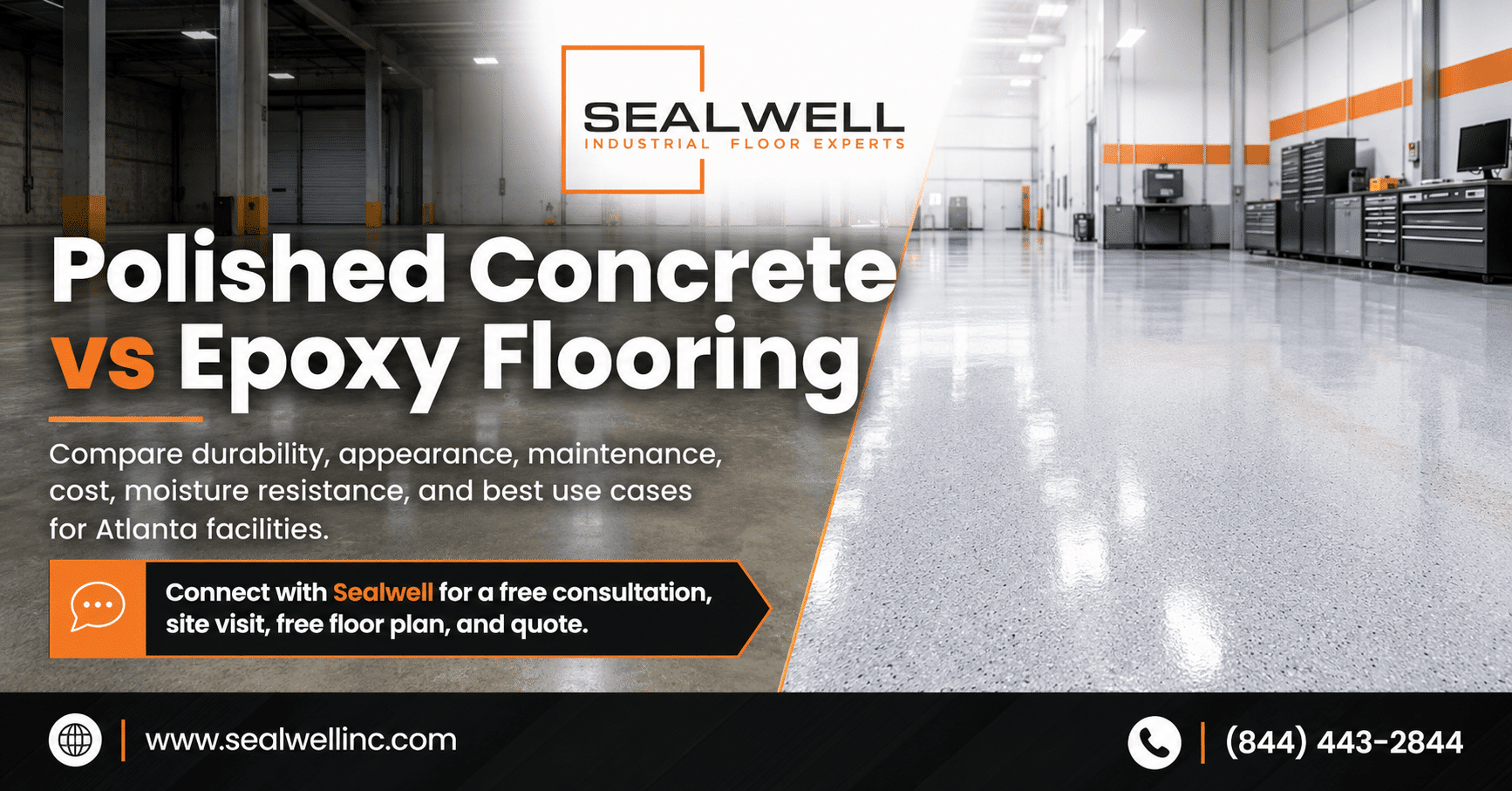
Commercial Flooring Atlanta projects often come down to two popular options: polished concrete and epoxy flooring. Polished concrete is a strong choice for facilities that want a clean, durable, low-maintenance surface with a natural concrete look. Epoxy flooring is often better for spaces that need stronger chemical resistance, custom colors, slip resistance, moisture protection, and heavy-duty concrete protection. The best option depends on traffic, appearance goals, maintenance needs, cost, moisture exposure, chemical use, and how each area of the facility operates.
For Atlanta warehouses, retail stores, showrooms, commercial buildings, manufacturing spaces, service areas, and industrial facilities, both polished concrete and epoxy flooring can deliver long-term value when installed properly. However, they are not the same flooring system, and each one performs better in different environments.
What Is Polished Concrete?
Polished concrete is created by mechanically grinding, refining, densifying, and polishing the existing concrete slab. The process turns the concrete surface into a smoother, harder, and more attractive floor.
Because polished concrete uses the existing slab, it can be a practical option for businesses that want a clean and modern finish without applying a thick coating layer. It is often used in warehouses, retail stores, offices, showrooms, schools, distribution spaces, and light industrial environments.
Polished concrete can offer a professional appearance, strong wear resistance, improved light reflectivity, and lower maintenance needs compared with untreated concrete. It also helps reduce concrete dusting by strengthening the surface.
What Is Epoxy Flooring?
Epoxy flooring is a resinous coating system installed over prepared concrete. It creates a seamless protective layer that can resist abrasion, stains, chemicals, moisture, and daily commercial or industrial traffic.
Epoxy flooring is commonly used in warehouses, manufacturing plants, automotive shops, service bays, commercial kitchens, healthcare facilities, laboratories, and industrial buildings. It can be customized with colors, flakes, quartz, safety markings, slip-resistant textures, and different topcoats.
Epoxy is often selected when the floor needs more protection than polished concrete can provide, especially in spaces exposed to chemicals, oils, grease, wet conditions, heavy equipment, or frequent cleaning.
Polished Concrete vs Epoxy Flooring: Comparison Table
|
Factor |
Polished Concrete |
Epoxy Flooring |
|
Durability |
Epoxy flooring, polished concrete, heavy-duty coatings Very durable for foot traffic, warehouse use, retail spaces, and general commercial areas. |
Highly durable for heavy traffic, forklifts, equipment, vehicles, and industrial use. |
|
Appearance |
Natural, clean, modern concrete finish with different gloss levels. |
Customizable with colors, flakes, quartz, gloss, safety markings, and decorative options. |
|
Maintenance |
Low-maintenance with regular sweeping, scrubbing, and periodic care. |
Easy to clean, but may need recoating over time depending on traffic and wear. |
|
Moisture Protection |
Helps improve surface performance, but does not create the same sealed protective layer as epoxy. |
Provides stronger surface protection against many spills and moisture exposures when properly specified. |
|
Chemical Resistance |
Limited chemical resistance compared with resinous coatings. |
Stronger resistance to oils, chemicals, solvents, cleaners, and industrial fluids depending on system. |
|
Cost |
Often cost-effective when the slab is in good condition. |
Cost varies based on thickness, preparation, topcoat, chemical resistance, and customization. |
|
Slip Resistance |
Can be managed with finish level and maintenance, but very high-gloss surfaces may need planning. |
Can be customized with slip-resistant texture for wet or high-risk areas. |
|
Best Use Cases |
Warehouses, retail stores, showrooms, offices, schools, distribution areas, and dry commercial spaces. |
Manufacturing plants, auto shops, kitchens, warehouses, service bays, chemical areas, and heavy-use spaces. |
|
Potential Limitation |
Existing cracks, stains, or patch marks may remain visible after polishing. |
Poor preparation or moisture issues can lead to peeling or coating failure. |
Which Option Is More Durable?
Both polished concrete and epoxy flooring can be durable, but they perform differently.
Polished concrete is highly durable because it hardens and refines the existing concrete surface. It works well in many Atlanta commercial facilities with foot traffic, carts, storage activity, and general warehouse use. It can reduce dusting and improve the appearance of old concrete.
Epoxy flooring provides a protective coating over the concrete. It is often better for heavy-use areas where the floor must resist abrasion, forklifts, pallet jacks, vehicles, chemicals, stains, or repeated cleaning. For more demanding industrial spaces, epoxy may offer stronger surface protection.
The right choice depends on how aggressive the environment is.
Which Looks Better for Commercial Spaces?
Appearance depends on the style the facility wants.
Polished concrete has a natural, modern, industrial look. It can be finished in different gloss levels, from matte to high gloss. It is popular in retail spaces, showrooms, offices, and warehouses that want a clean and professional appearance.
Epoxy flooring offers more design flexibility. It can be installed in solid colors, decorative flakes, quartz finishes, safety colors, or branded floor designs. It is useful when a business wants a more controlled or customized appearance.
For a natural concrete look, polished concrete is often preferred. For a more colorful, decorative, or branded finish, epoxy flooring may be the better option.
Which Is Easier to Maintain?
Both systems are easier to maintain than untreated concrete.
Polished concrete usually requires sweeping, dust mopping, wet cleaning, and periodic maintenance to preserve the finish. It is low-maintenance, but it should be cleaned with suitable products to avoid dulling the surface.
Epoxy flooring is also easy to clean because it creates a seamless, sealed surface. Spills, dust, oils, and dirt can be removed more easily than from porous concrete. However, in high-traffic facilities, epoxy may eventually need recoating to restore gloss, texture, or topcoat performance.
For dry commercial spaces, polished concrete can be very low maintenance. For wet, chemical, or industrial areas, epoxy may be easier to protect and clean.
Which Costs More?
Cost depends on the condition of the concrete, square footage, preparation needs, finish level, system thickness, and project complexity.
Polished concrete may be more cost-effective when the existing slab is in good condition. However, if the slab has cracks, stains, old coatings, glue, spalling, or uneven areas, preparation and repair costs can increase.
Epoxy flooring cost depends on the coating system selected. A basic epoxy system may cost less than a heavy-duty epoxy system with multiple layers, slip resistance, chemical protection, or decorative finishes. Epoxy may cost more upfront in demanding spaces, but it can provide better long-term protection where the floor faces heavy exposure.
The best way to compare cost is through a professional site visit and flooring recommendation.
Which Handles Moisture Better?
Moisture is an important concern for Atlanta facilities. Rainwater, humidity, slab moisture, wet cleaning, loading docks, kitchens, and service areas can all affect floor performance.
Polished concrete can perform well in many dry or moderate-use spaces, but it does not create the same protective barrier as a resinous coating. If the space is regularly exposed to moisture, spills, washdowns, or chemicals, another system may be needed.
Epoxy flooring can offer better surface protection against many types of moisture exposure when properly selected and installed. However, moisture vapor coming from within the slab must be tested before installation. If epoxy is installed over excessive slab moisture without mitigation, bubbling or peeling may occur.
Moisture testing is important before choosing either system.
Which Handles Chemical Exposure Better?
Epoxy flooring is usually the better option for chemical exposure.
Facilities such as auto shops, manufacturing plants, laboratories, commercial kitchens, and service bays may deal with oils, solvents, degreasers, cleaners, sanitizers, and industrial liquids. Epoxy systems can be designed to resist many of these exposures.
Polished concrete can resist normal wear and cleaning, but it may stain or react poorly when exposed to certain chemicals or oils. If chemical resistance is a major requirement, epoxy or another resinous flooring system may be more suitable.
Best Use Cases for Polished Concrete
Polished concrete may be a good choice for:
- Retail stores
- Showrooms
- Warehouses
- Distribution centers
- Offices
- Schools
- Dry commercial spaces
- Light industrial spaces
- Customer-facing commercial interiors
It works especially well when the business wants a clean, durable, low-maintenance floor with a natural concrete appearance.
Best Use Cases for Epoxy Flooring
Epoxy flooring may be a good choice for:
- Manufacturing plants
- Auto shops
- Service bays
- Warehouses with heavy traffic
- Commercial kitchens
- Food facilities
- Laboratories
- Healthcare spaces
- Chemical exposure areas
- Wet or spill-prone spaces
It is often the better choice when the floor needs stronger protection, slip resistance, chemical resistance, and customization.
Can Atlanta Facilities Use Both Flooring Systems?
Yes. Many facilities use polished concrete in some areas and epoxy flooring in others.
For example, a warehouse may use polished concrete in dry storage areas and epoxy flooring in chemical handling zones, loading areas, or maintenance rooms. A commercial building may use polished concrete in customer-facing spaces and epoxy in service areas.
Using the right system in the right area can help improve performance, reduce maintenance issues, and control long-term costs.
How to Choose the Right Flooring System
Before choosing between polished concrete and epoxy flooring, consider these questions:
- How much traffic will the floor receive?
- Will forklifts, pallet jacks, carts, or vehicles be used?
- Will the floor be exposed to chemicals, oils, or cleaners?
- Is moisture or wet cleaning common?
- Does the space need slip resistance?
- Is appearance or branding important?
- What is the condition of the existing concrete?
- How much downtime can the facility allow?
- What are the long-term maintenance expectations?
A professional flooring assessment can help answer these questions and recommend the right system.
Why Sealwell Team Experts?
Sealwell helps Atlanta businesses choose the right flooring system based on real facility needs. Our team can inspect your concrete, review traffic levels, identify moisture or slab concerns, evaluate chemical exposure, and recommend whether polished concrete, epoxy flooring, or another commercial flooring system is the right fit.
Whether your facility needs a polished concrete finish for a clean modern look or epoxy flooring for heavy-duty protection, Sealwell can help you plan a durable and practical solution.
Why Sealwell Team Experts? Connect with Sealwell team for free consultation, visit and with a free floor plan and quote.
For businesses comparing polished concrete and epoxy options, Commercial Flooring Atlanta solutions should be selected based on durability, appearance, maintenance, cost, moisture, chemical exposure, and long-term facility performance.
FAQs About Polished Concrete vs Epoxy Flooring
Is polished concrete better than epoxy flooring?
Polished concrete is better for dry commercial spaces that need a natural, low-maintenance finish. Epoxy flooring is better for areas that need chemical resistance, moisture protection, custom finishes, or heavy-duty surface protection.
Is epoxy flooring more durable than polished concrete?
Epoxy flooring can provide stronger surface protection in heavy-use and chemical-exposure areas. Polished concrete is also durable, especially for warehouses, retail spaces, and general commercial use.
Which flooring is easier to maintain?
Both are easy to maintain. Polished concrete needs routine cleaning and periodic care to preserve the finish. Epoxy flooring is easy to clean but may need recoating over time in high-traffic areas.
Which option is better for warehouses?
Both can work for warehouses. Polished concrete is a strong option for dry storage and general traffic areas, while epoxy may be better for heavy equipment, chemicals, wet zones, or high-impact areas.
Does epoxy flooring cost more than polished concrete?
It depends on the project. Polished concrete may be more cost-effective if the slab is in good condition. Epoxy cost depends on system thickness, surface preparation, topcoat, slip resistance, and chemical resistance needs.
Can polished concrete resist chemicals?
Polished concrete has limited chemical resistance compared with epoxy. If the floor will be exposed to oils, solvents, degreasers, or harsh cleaners, epoxy may be a better option.
Can epoxy flooring peel?
Epoxy flooring can peel if the concrete is not prepared properly, moisture is ignored, or the wrong system is installed. Proper surface preparation and moisture testing help reduce this risk.
Which flooring is better for customer-facing spaces?
Polished concrete works well for a clean, modern, natural appearance. Epoxy flooring works well when a business wants custom colors, flakes, decorative finishes, or branded floor design.
Can both polished concrete and epoxy be slip-resistant?
Yes. Both systems can be planned for safer movement, but epoxy flooring offers more direct slip-resistant texture options for wet or high-risk areas.
How do I know which system is right for my facility?
A professional site visit is the best way to decide. The contractor should review traffic, moisture, chemicals, slab condition, appearance goals, safety needs, and maintenance expectations.
Our trusted clients: