
Blog and News
Epoxy vs Polished Concrete: Which Is Better for Warehouses in Georgia?
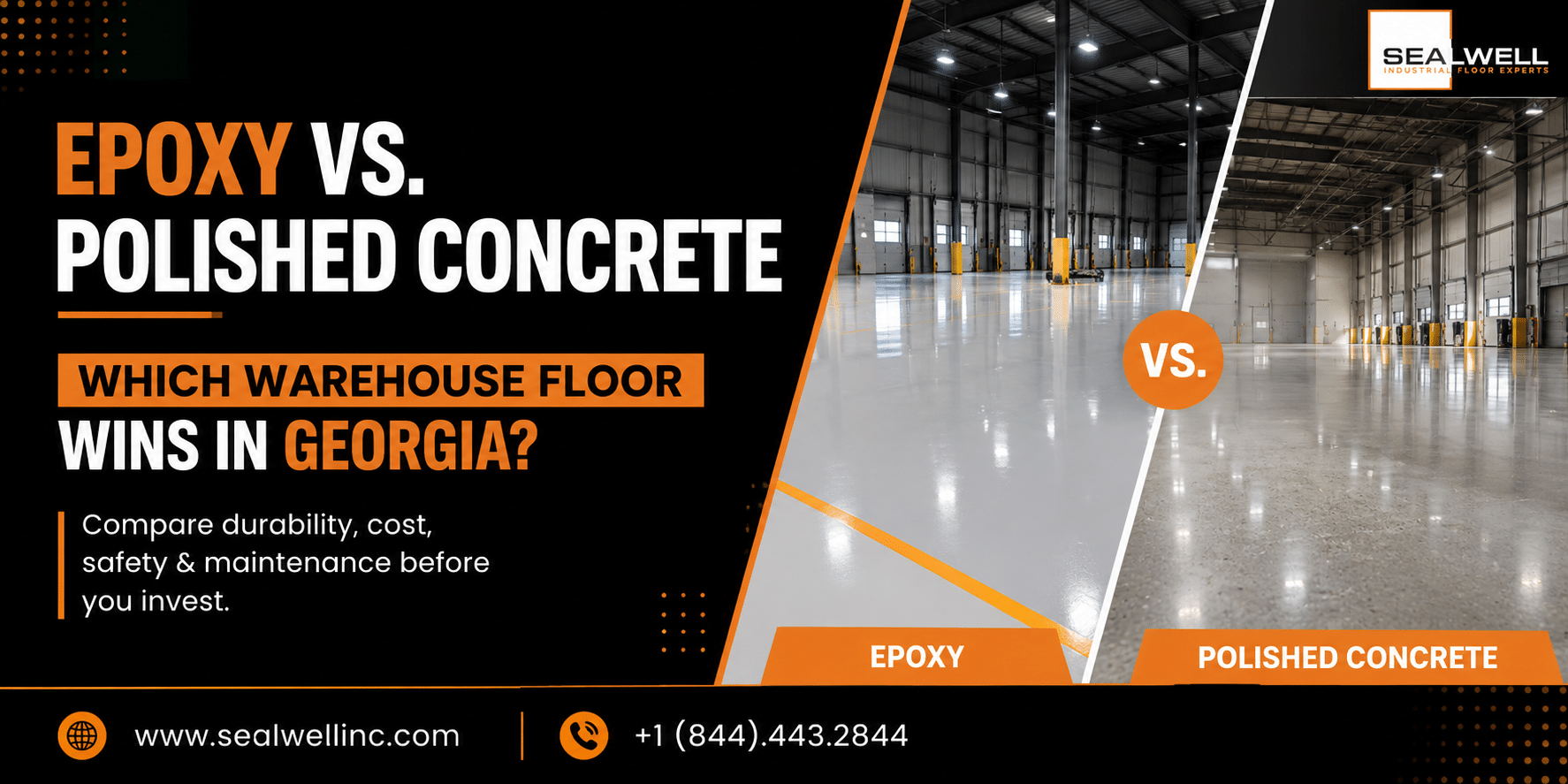
Choosing the right warehouse floor is a major decision for any business. Your floor supports forklifts, pallet jacks, storage racks, employees, equipment, inventory movement, cleaning routines, and daily operations. If the wrong system is selected, the result can be dusting concrete, stains, cracks, safety concerns, maintenance problems, and expensive downtime.
For many facility owners and property managers, the comparison often comes down to two popular options: epoxy flooring and polished concrete.
Both systems can work well in commercial and industrial environments, but they are not the same. The best choice depends on how your warehouse is used, the condition of the concrete, traffic levels, cleaning requirements, chemical exposure, safety needs, and long-term maintenance goals.
If you are planning Warehouse Flooring in Georgia, this guide from Sealwell will help you understand the difference between epoxy and polished concrete so you can make a more confident flooring decision.
What Is Epoxy Warehouse Flooring?
Epoxy flooring is a resin-based floor coating system applied over prepared concrete. Once installed and cured, it creates a seamless, durable surface that protects the concrete underneath.
For warehouses, epoxy can be designed for heavy traffic, forklift movement, pallet jack use, chemical exposure, abrasion resistance, and easier cleaning. It can also include slip-resistant texture, safety line striping, color zones, and protective topcoats.
Epoxy is commonly used in warehouses, manufacturing plants, automotive facilities, distribution centers, storage buildings, retail backrooms, and industrial spaces that need a protective surface over concrete.
What Is Polished Concrete?
Polished concrete is created by mechanically grinding and polishing the existing concrete slab. The floor is refined with progressively finer diamond tooling until it reaches the desired level of smoothness and shine. A densifier is often used to harden the surface, and a guard or stain protector may be added for extra resistance.
Polished concrete is not a coating in the same way epoxy is. Instead, it improves and finishes the existing slab. This makes it a popular choice for warehouses that want a clean, bright, low-maintenance floor without a thick coating system.
Polished concrete is often used in warehouses, retail stores, distribution centers, showrooms, big-box spaces, and commercial buildings where appearance, light reflectivity, and ease of maintenance are important.
Epoxy vs Polished Concrete: Key Differences
Both epoxy and polished concrete can improve warehouse floors, but they perform differently.
Epoxy creates a protective coating over concrete. Polished concrete enhances the concrete itself. Epoxy can offer stronger protection against chemicals, stains, spills, and heavy industrial exposure. Polished concrete can provide a long-lasting, attractive surface with lower coating-related maintenance because there is no thick film layer to peel.
For Warehouse Flooring in Georgia, the right choice depends on your building’s conditions and how demanding your operations are.
Durability for Forklifts and Pallet Jacks
Warehouse floors take daily abuse from forklifts, pallet jacks, carts, racks, and constant product movement. Both epoxy and polished concrete can handle traffic when properly installed, but the type of traffic matters.
Epoxy may be better for areas with heavy impact, chemical spills, oil exposure, or frequent equipment movement. A high-build epoxy system with a durable topcoat can protect concrete from wear and staining.
Polished concrete can also perform well under forklift traffic, especially in dry warehouses with moderate to heavy movement. Because it is the concrete surface itself, it does not have a coating layer that can be scratched through. However, polished concrete may be more vulnerable to certain stains, tire marks, and chemicals if not maintained properly.
Best choice for heavy industrial use: Epoxy
Best choice for dry storage and general warehouse traffic: Polished concrete or epoxy, depending on slab condition
Resistance to Chemicals, Oil, and Spills
If your warehouse handles chemicals, oils, automotive fluids, food products, cleaning agents, or industrial liquids, epoxy often provides better protection. Epoxy systems can be designed with chemical-resistant topcoats to reduce staining and protect the slab.
Polished concrete can resist some everyday wear, but it is still concrete. If spills are left sitting, the surface may stain or etch, especially if acids, oils, or harsh chemicals are involved.
For warehouses that store or handle liquids, an epoxy system may be the better long-term investment.
Best choice for chemical resistance: Epoxy
Maintenance and Cleaning
Maintenance is one of the biggest factors in warehouse flooring decisions.
Epoxy floors are generally easy to clean because they create a seamless, non-porous surface. Dust, dirt, oil, and spills are easier to remove compared to untreated concrete. However, epoxy may require recoating over time, especially in high-traffic zones.
Polished concrete is also easy to maintain when properly installed and cared for. It does not require waxing, and it can hold up well with regular dust mopping, autoscrubbing, and periodic maintenance. In very busy warehouses, polished concrete may need guard reapplication or periodic burnishing to maintain appearance and stain resistance.
Best choice for lowest routine maintenance: Polished concrete
Best choice for spill protection and easy cleanup: Epoxy
Safety and Slip Resistance
Warehouse safety should never be an afterthought. Floors must support workers, equipment movement, loading zones, and daily traffic patterns.
Epoxy can be customized with slip-resistant additives, textures, color zones, aisle markings, and safety striping. This makes it a strong choice for warehouses that need clear walking paths, forklift lanes, loading dock markings, or hazard zones.
Polished concrete can also provide good traction when properly finished, but high-gloss polished floors may need careful specification to balance shine and slip resistance. Areas exposed to water, dust, or oil may need additional treatment.
For facilities that need visible safety markings or textured traction, epoxy offers more customization.
Best choice for safety markings and slip-resistant texture: Epoxy
Appearance and Light Reflectivity
A clean, bright warehouse can improve visibility and create a more professional environment. Both epoxy and polished concrete can improve the appearance of a warehouse floor.
Epoxy offers more design control. It can be installed in solid colors, flake systems, quartz systems, safety colors, or customized zones. This can help separate work areas, pedestrian paths, storage zones, and equipment lanes.
Polished concrete offers a natural, modern, reflective look. It can brighten the space and create a clean industrial appearance. However, the final appearance depends heavily on the existing concrete slab. If the slab has stains, patches, cracks, or uneven aggregate exposure, those features may still show after polishing.
Best choice for custom color and branding: Epoxy
Best choice for natural industrial appearance: Polished concrete
Downtime and Installation Timeline
Downtime is a major concern for warehouses. Many facilities cannot afford long shutdowns, especially if they operate around the clock.
Epoxy installation usually includes surface preparation, primer, coating layers, topcoat, and curing. The timeline depends on square footage, concrete condition, humidity, temperature, and system type. Some epoxy systems require more cure time before forklifts and heavy equipment can return.
Polished concrete may allow a more flexible installation schedule in some warehouses because it does not require the same multi-layer curing process. However, polishing still requires equipment access, dust control, grinding, densifying, and finishing time.
Both options can often be installed in phases to reduce operational disruption.
Best choice for faster return in some dry warehouse environments: Polished concrete
Best choice when protection and safety customization outweigh downtime concerns: Epoxy
Cost Considerations
Cost depends on the size of the warehouse, slab condition, preparation needs, system type, repair work, and project schedule.
Polished concrete can sometimes be more cost-effective for large open warehouses with a good existing slab. Epoxy may cost more when heavy surface preparation, multiple coating layers, moisture control, or chemical-resistant systems are needed.
However, the lowest upfront cost is not always the best long-term value. If a warehouse needs chemical protection, slip resistance, line striping, or heavy-duty performance, epoxy may help reduce long-term damage and maintenance costs.
For accurate pricing on Warehouse Flooring in Georgia, Sealwell recommends a site visit and floor evaluation.
How Georgia Climate Can Affect Warehouse Floors
Georgia’s climate can include humidity, rain, heat, and seasonal temperature changes. These conditions may affect concrete slabs, moisture levels, coating adhesion, and long-term floor performance.
Before installing epoxy or polishing concrete, it is important to evaluate the slab condition. Moisture testing may be recommended if there are concerns about vapor transmission, damp areas, previous coating failure, or ground-level slabs.
Proper preparation helps reduce the risk of coating failure, surface dusting, staining, and premature wear.
Which Flooring Is Better for Your Warehouse?
There is no single answer for every facility. Epoxy and polished concrete are both strong options, but they serve different needs.
Choose epoxy if your warehouse needs:
- Chemical resistance
- Oil and spill protection
- Slip-resistant texture
- Safety striping or color zones
- Heavy-duty surface protection
- A clean, seamless finish
- Better stain resistance
- Custom appearance options
Choose polished concrete if your warehouse needs:
- A natural concrete appearance
- Good light reflectivity
- Lower coating maintenance
- A durable surface for dry storage
- A cost-effective option for large open spaces
- Minimal decorative requirements
- No thick coating layer
Many warehouses also benefit from a combination approach. For example, polished concrete may work well in general storage areas, while epoxy may be better for loading docks, maintenance rooms, chemical storage areas, production zones, or high-spill areas.
Why Choose Sealwell for Warehouse Flooring in Georgia?
Sealwell helps warehouse owners, facility managers, and business operators choose flooring systems based on real operating conditions. Our team understands that every facility is different. A distribution warehouse does not need the same floor as an automotive parts warehouse, food storage facility, manufacturing plant, or logistics center.
Sealwell can help evaluate:
- Existing concrete condition
- Forklift and pallet jack traffic
- Moisture concerns
- Cleaning requirements
- Chemical exposure
- Safety marking needs
- Downtime limitations
- Budget and long-term maintenance goals
- Best floor system for each zone
Whether you are comparing epoxy, polished concrete, or another industrial flooring solution, Sealwell can guide you through the process from consultation to floor planning.
Get a Free Warehouse Flooring Consultation
If you are deciding between epoxy and polished concrete, the best next step is a professional floor evaluation. A site visit can help identify concrete conditions, traffic demands, safety needs, moisture concerns, and the right system for your warehouse.
Connect with the Sealwell team for a free consultation, site visit, and floor plan.
Sealwell will review your space, discuss your goals, and recommend the best solution for Warehouse Flooring in Georgia.
FAQ: Epoxy vs Polished Concrete for Warehouses in Georgia
Is epoxy or polished concrete better for warehouses?
Epoxy is usually better for warehouses that need chemical resistance, slip-resistant texture, safety markings, and heavy-duty protection. Polished concrete is often better for dry warehouses that want a durable, reflective, low-maintenance concrete surface.
What is the best flooring for warehouse forklift traffic?
Both epoxy and polished concrete can support forklift traffic when properly installed. Epoxy may be better for heavy industrial use, chemical exposure, and safety zones. Polished concrete may work well for dry storage and general distribution areas.
Is polished concrete cheaper than epoxy for warehouses?
Polished concrete can sometimes be more cost-effective for large warehouses with a good existing slab. Epoxy may cost more if the floor needs multiple coating layers, chemical resistance, crack repairs, or slip-resistant texture.
Does epoxy flooring last longer than polished concrete?
The lifespan depends on traffic, maintenance, installation quality, and facility use. Epoxy can last a long time in demanding environments when properly installed and maintained. Polished concrete can also last for years, especially in dry warehouses with regular cleaning.
Which warehouse floor is easier to clean?
Both floors are easier to clean than untreated concrete. Epoxy provides a seamless coated surface that helps resist spills and stains. Polished concrete is also easy to maintain with regular dust mopping, auto scrubbing, and periodic care.
Can epoxy flooring be installed in an active warehouse?
In many cases, epoxy flooring can be installed in phases to reduce downtime. Sealwell may recommend section-by-section installation, weekend scheduling, or after-hours work depending on the facility layout and floor system.
Can polished concrete stain in a warehouse?
Yes. Polished concrete can stain if oils, chemicals, acids, or spills are left on the surface. Protective guards can help, but polished concrete may not provide the same level of spill resistance as epoxy.
Which floor is better for warehouse safety markings?
Epoxy is usually better for warehouse safety markings because it allows custom colors, forklift lanes, pedestrian walkways, loading zones, and hazard areas to be built into the flooring system.
Does Georgia humidity affect warehouse flooring?
Yes. Georgia humidity and slab moisture can affect warehouse floors, especially coated systems. Moisture testing may be recommended before installing epoxy or other floor coatings.
How do I choose the right warehouse flooring in Georgia?
The best way to choose the right warehouse flooring is to evaluate your concrete condition, traffic level, chemical exposure, cleaning process, safety needs, budget, and downtime requirements. Sealwell can provide a free consultation, site visit, and floor plan.
SEALWELL INC
Phone No– +1 (844)-443-2844
Email- in*******@se*********.com
Let’s Connect: www.sealwellinc.com
Our trusted clients: