
Blog and News
Industrial Flooring Compliance in Florida: What Facilities Should Know
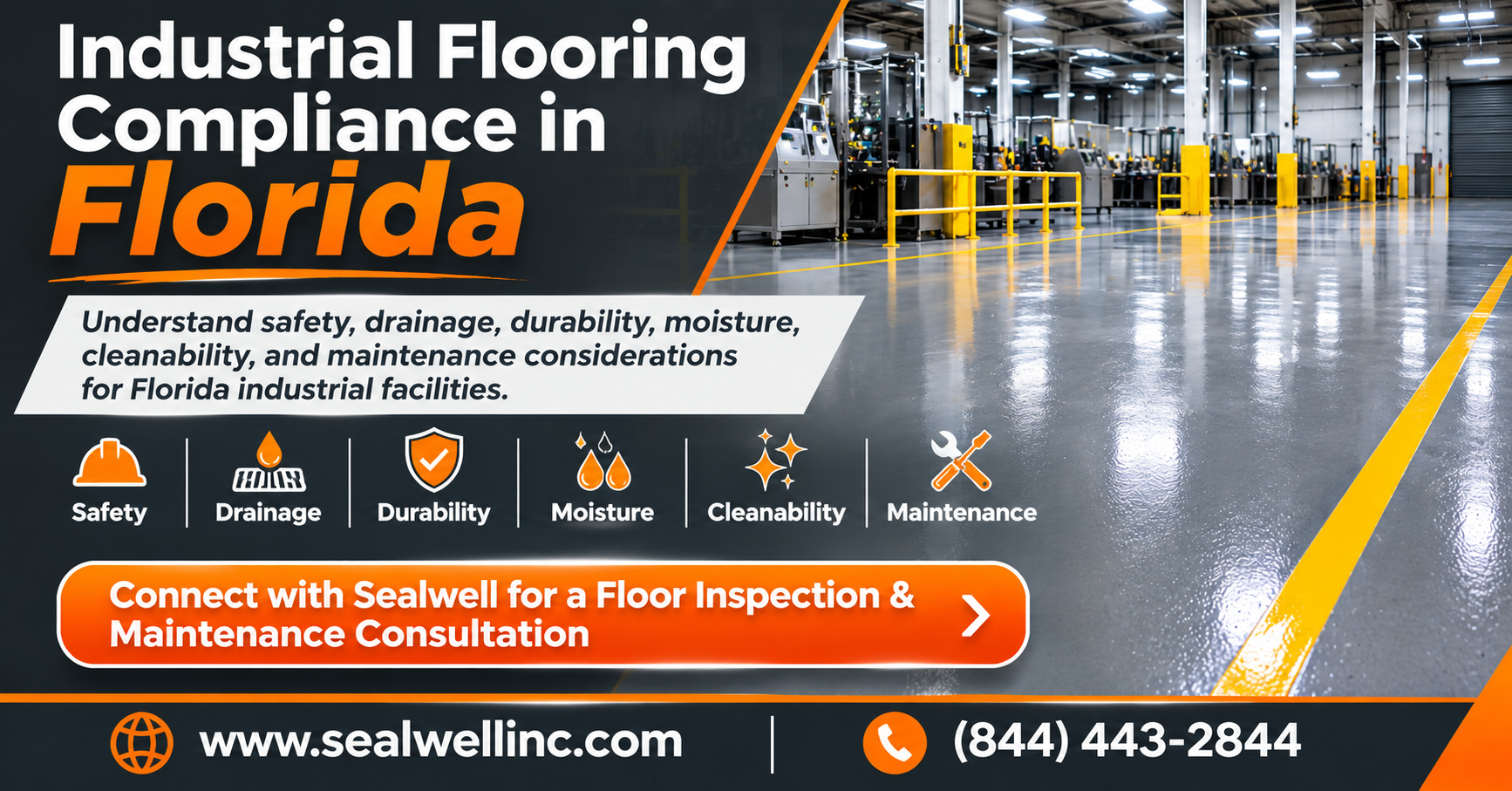
For manufacturers, warehouses, food-processing facilities, healthcare environments, distribution centers, and other industrial properties, Industrial Flooring Compliance in Florida is an important part of maintaining a safe, functional, and inspection-ready facility. Flooring is not simply a finish applied to concrete; it can affect employee safety, sanitation, drainage, equipment movement, maintenance, and the long-term performance of the building. The exact requirements depend on the facility’s use, applicable building codes, OSHA requirements, industry regulations, and local enforcement.
Florida’s construction requirements are governed through the Florida Building Code, while workplace safety requirements can also apply under federal OSHA standards. The Florida Building Commission identifies the 9th Edition (2026) Florida Building Code and related code resources, so facility owners and contractors should confirm which edition and local requirements apply to their project.
What Does Industrial Flooring Compliance Mean?
Industrial flooring compliance generally means designing, installing, maintaining, and repairing floors so they are appropriate for the facility’s intended use and meet applicable requirements.
There is no single flooring material that is automatically compliant for every industrial environment. A warehouse, commercial kitchen, pharmaceutical facility, manufacturing plant, and aircraft hangar may have very different performance requirements.
Depending on the facility, flooring considerations can include:
- Employee safety and slip resistance
- Floor load capacity
- Durability and impact resistance
- Drainage
- Cleanability and sanitation
- Chemical resistance
- Moisture management
- Surface condition
- Accessibility
- Maintenance and repair
- Industry-specific requirements
The right flooring system should therefore be selected based on the actual operating environment rather than simply choosing the most durable or expensive product.
How Does OSHA Apply to Industrial Floors?
OSHA’s Walking-Working Surfaces standard, 29 CFR 1910.22, requires employers to keep walking-working surfaces clean, orderly, and sanitary. Floors should be maintained in a clean and, where feasible, dry condition, while wet-process areas require appropriate drainage and, where practicable, dry standing areas. OSHA also requires walking-working surfaces to be inspected regularly and hazardous conditions to be corrected or guarded before employees use the affected surface.
This makes floor maintenance an important part of workplace safety.
For example, an industrial facility should not wait until a damaged floor becomes a serious trip hazard before addressing it. Cracks, holes, loose materials, leaks, spills, and deteriorated surfaces should be identified and corrected as part of an ongoing maintenance program.
Why Is Slip Resistance Important?
Slip resistance is particularly important in facilities exposed to water, oils, chemicals, food products, cleaning solutions, or other substances that may reduce traction.
A flooring system may need a textured or aggregate finish in areas where smooth surfaces could become slippery during normal operations. However, increasing texture can also affect cleanability, so the appropriate balance depends on the facility.
OSHA emphasizes maintaining walking-working surfaces free from hazards such as leaks and spills. Its guidance also recognizes that slip-resistant surfaces can be useful in areas exposed to wet, oily, or dirty operations.
For facility managers, the goal should be to select a floor finish appropriate for the actual conditions rather than assuming that one surface profile works everywhere.
What Flooring Requirements Apply to Food and Beverage Facilities?
Food-related facilities have additional sanitation and cleanability considerations.
The Florida Department of Agriculture and Consumer Services states that food establishment floor surfaces must be smooth, nonabsorbent, and easy to clean. It also identifies floor drains for rooms receiving flush or flood cleaning or where normal operations release water or liquid waste, with floors graded to drain effectively and floor-wall junctures properly addressed.
The FDA Food Code provides a model framework used by food-control jurisdictions and states that food establishment floors should be designed, constructed, and installed to be smooth and easily cleanable, with specific requirements for floor-wall junctures and drainage in facilities using water-flush cleaning methods.
For Florida food facilities, flooring decisions should therefore consider more than durability. The system should also support the facility’s sanitation, drainage, cleaning, and operational requirements.
Why Is Drainage Important for Industrial Flooring?
Drainage becomes especially important in wet-process environments.
Manufacturing facilities, food-processing areas, commercial kitchens, washdown spaces, and other wet environments may routinely use water or cleaning solutions. If the floor does not drain properly, standing water can create sanitation and slip concerns.
When designing or renovating these areas, facility teams should consider:
- Floor slope
- Drain locations
- Floor-wall transitions
- Seamless surfaces
- Waterproofing or moisture considerations
- Cleaning methods
- Frequency of washdown
The flooring material is only one component of the overall system. The substrate, slope, drains, joints, wall transitions, and cleaning process all influence performance.
How Does Chemical Resistance Affect Flooring Selection?
Industrial facilities may use oils, solvents, acids, alkalis, fuels, cleaning agents, or manufacturing chemicals.
A flooring system should be selected based on the actual chemicals present, their concentration, temperature, frequency of exposure, and expected contact time.
Epoxy, urethane, MMA, and other resinous systems can offer different levels of chemical resistance. However, no flooring material should be assumed to resist every chemical under every condition.
Before selecting a system, facility managers should provide the flooring contractor with a list of relevant chemicals and operating conditions.
What About Heavy Equipment and Floor Loads?
Industrial flooring must support the loads created by the facility’s operations.
Warehouses and manufacturing plants may have:
- Forklifts
- Pallet jacks
- Heavy machinery
- Automated equipment
- Material handling carts
- Vehicles
- Storage racks
- High-frequency traffic
OSHA requires employers to ensure that walking-working surfaces can support the maximum intended load for the surface.
A flooring assessment should therefore consider not only the coating but also the condition and capacity of the underlying concrete.
Why Does Moisture Matter in Florida Flooring Projects?
Florida facilities can face moisture-related challenges because of the state’s humid climate, rainfall, groundwater conditions, cleaning processes, and building-specific moisture sources.
Moisture vapor within a concrete slab can also affect the performance of certain coating systems. If moisture conditions are not properly evaluated before installation, flooring problems such as blistering, bubbling, or adhesion failure may occur.
Before installing a new coating, Sealwell recommends evaluating the existing concrete and determining whether moisture testing or mitigation is appropriate for the project.
Does Flooring Need to Be Easy to Maintain?
Yes. Compliance and facility performance do not end after installation.
A floor that is difficult to clean, frequently damaged, or poorly maintained can eventually become a safety and operational concern.
Facility maintenance programs should include:
- Routine cleaning
- Spill response
- Periodic inspections
- Crack and joint monitoring
- Coating inspections
- Prompt repairs
- Appropriate cleaning chemicals
- Documentation of recurring problem areas
OSHA specifically requires walking-working surfaces to be inspected regularly and maintained in a safe condition.
Comparing Flooring Requirements by Facility Type
|
Facility Type |
Key Flooring Considerations |
Common Performance Priorities |
|
Manufacturing |
Heavy traffic, equipment, chemicals |
Durability, impact and chemical resistance |
|
Warehouse |
Forklifts, pallet jacks, storage loads |
Abrasion resistance, load performance, safety |
|
Food Processing |
Water, sanitation, washdown |
Nonabsorbency, cleanability, drainage |
|
Commercial Kitchen |
Grease, water, cleaning |
Slip resistance, drainage, cleanability |
|
Healthcare |
Hygiene, traffic, maintenance |
Cleanability, durability, safety |
|
Automotive |
Oils, fuels, vehicle traffic |
Chemical resistance, abrasion resistance |
|
Electronics |
Static-sensitive processes |
ESD control, cleanability, durability |
|
Aviation |
Heavy loads, fluids, equipment |
Chemical resistance, durability, impact resistance |
This comparison is a planning guide rather than a substitute for reviewing the requirements applicable to a specific facility.
What Should Facilities Check Before Installing Industrial Flooring?
Before installing a new floor coating or resurfacing system, facility managers should evaluate the existing floor.
A professional inspection can review:
- Concrete condition — cracks, spalling, weak areas, joints, and surface deterioration.
- Moisture — potential moisture vapor or water-related concerns.
- Existing coatings — adhesion, peeling, delamination, and compatibility.
- Traffic — forklifts, equipment, vehicles, and pedestrian movement.
- Chemical exposure — products used and their exposure conditions.
- Cleaning methods — chemicals, pressure washing, hot water, and frequency.
- Safety — slip, trip, drainage, and surface hazards.
- Operational requirements — downtime limitations and return-to-service expectations.
This assessment can help determine whether the facility needs concrete repair, polishing, epoxy, urethane, MMA, or another flooring system.
Is Epoxy Flooring Always the Best Choice?
Not necessarily.
Epoxy is a widely used industrial flooring option, but the best flooring system depends on the facility.
For example:
- Epoxy may be appropriate where durability, seamless protection, and chemical resistance are important.
- Urethane may be suitable for demanding environments requiring additional performance characteristics.
- MMA can be considered when rapid return to service is a priority.
- Polished concrete may be appropriate where a durable, low-maintenance finished concrete surface is desired.
- Concrete repair or resurfacing may be necessary when the existing slab requires correction before a finish is installed.
The right system should be matched to the facility’s conditions and compliance requirements.
How Can Regular Floor Maintenance Support Compliance?
A compliant flooring installation can still become problematic if it is neglected.
Facility managers should establish a maintenance schedule that identifies:
- Inspection frequency
- Cleaning procedures
- Spill response
- Repair priorities
- Coating wear
- Drainage issues
- Areas of recurring damage
- Safety concerns
Documentation can also help facilities demonstrate that flooring-related issues are being actively monitored and addressed.
Why Choose Sealwell for Industrial Flooring in Florida?
With more than 35 years of flooring industry experience, Sealwell is a leading commercial and industrial flooring specialist serving Florida and Georgia, with expanding capabilities nationwide.
Our team understands that industrial flooring requirements vary by facility. We evaluate the floor, operating conditions, traffic, moisture, chemical exposure, safety needs, and maintenance requirements before recommending a flooring solution.
Our services include epoxy flooring, urethane flooring, MMA flooring, polished concrete, concrete repair, resurfacing, ESD flooring, and protective coating systems.
The objective is not simply to install a floor. It is to help facility managers create a surface that supports safety, durability, cleanability, operational performance, and long-term maintenance.
Conclusion
Industrial Flooring Compliance in Florida involves more than selecting a coating that looks durable. Facility owners and managers need to consider applicable building requirements, OSHA workplace safety requirements, industry-specific rules, drainage, slip resistance, floor loads, chemical exposure, moisture, cleanability, installation quality, and ongoing maintenance. Because requirements vary by facility and use, a professional floor inspection is a practical starting point for identifying risks and determining the appropriate flooring system. Connect with the Sealwell team for a facility visit, floor inspection, and maintenance consultation to help keep your industrial flooring safe, durable, and ready for demanding operations.
Frequently Asked Questions (FAQs)
What are the flooring requirements for industrial facilities in Florida?
There is no single flooring requirement covering every industrial facility. Requirements depend on building codes, OSHA rules, facility use, local enforcement, and industry-specific regulations. Food facilities, for example, have additional sanitation and cleanability considerations.
Does OSHA require industrial floors to be slip resistant?
OSHA requires employers to maintain walking-working surfaces in a safe condition and address hazards such as spills, leaks, and other unsafe conditions. The appropriate floor surface depends on the specific workplace conditions.
What type of flooring is best for Florida manufacturing facilities?
There is no universal best option. Epoxy, urethane, MMA, polished concrete, and other systems may be appropriate depending on traffic, chemicals, moisture, safety, maintenance, and operational requirements.
Is epoxy flooring suitable for food processing facilities?
Epoxy can be suitable for certain food-processing applications, but the complete flooring system must be selected and installed to meet the facility’s sanitation, drainage, cleanability, and other applicable requirements. Florida’s food establishment standards specify smooth, nonabsorbent, easy-to-clean floor surfaces.
Why is drainage important for industrial flooring?
Proper drainage helps prevent standing water in wet-process environments and supports cleaning, sanitation, and workplace safety. Florida food establishment standards specifically address drainage and floor grading in areas subject to flush or flood cleaning.
How often should industrial floors be inspected?
Inspection frequency depends on facility traffic, floor system, exposure, and operating conditions. OSHA requires walking-working surfaces to be inspected regularly and maintained safely.
Can Sealwell inspect an existing industrial floor?
Yes. Sealwell can evaluate existing commercial and industrial floors to identify visible deterioration, coating failure, concrete damage, moisture-related concerns, safety issues, and maintenance needs.
What should I do if my industrial floor is already damaged?
Damaged areas should be evaluated promptly. Depending on the condition, the appropriate solution may involve concrete repair, resurfacing, polishing, recoating, or complete flooring replacement.
Our trusted clients: