Blog and News
Floor Repairs Near Me: Repair, Resurface, or Replace Your Commercial Floors?
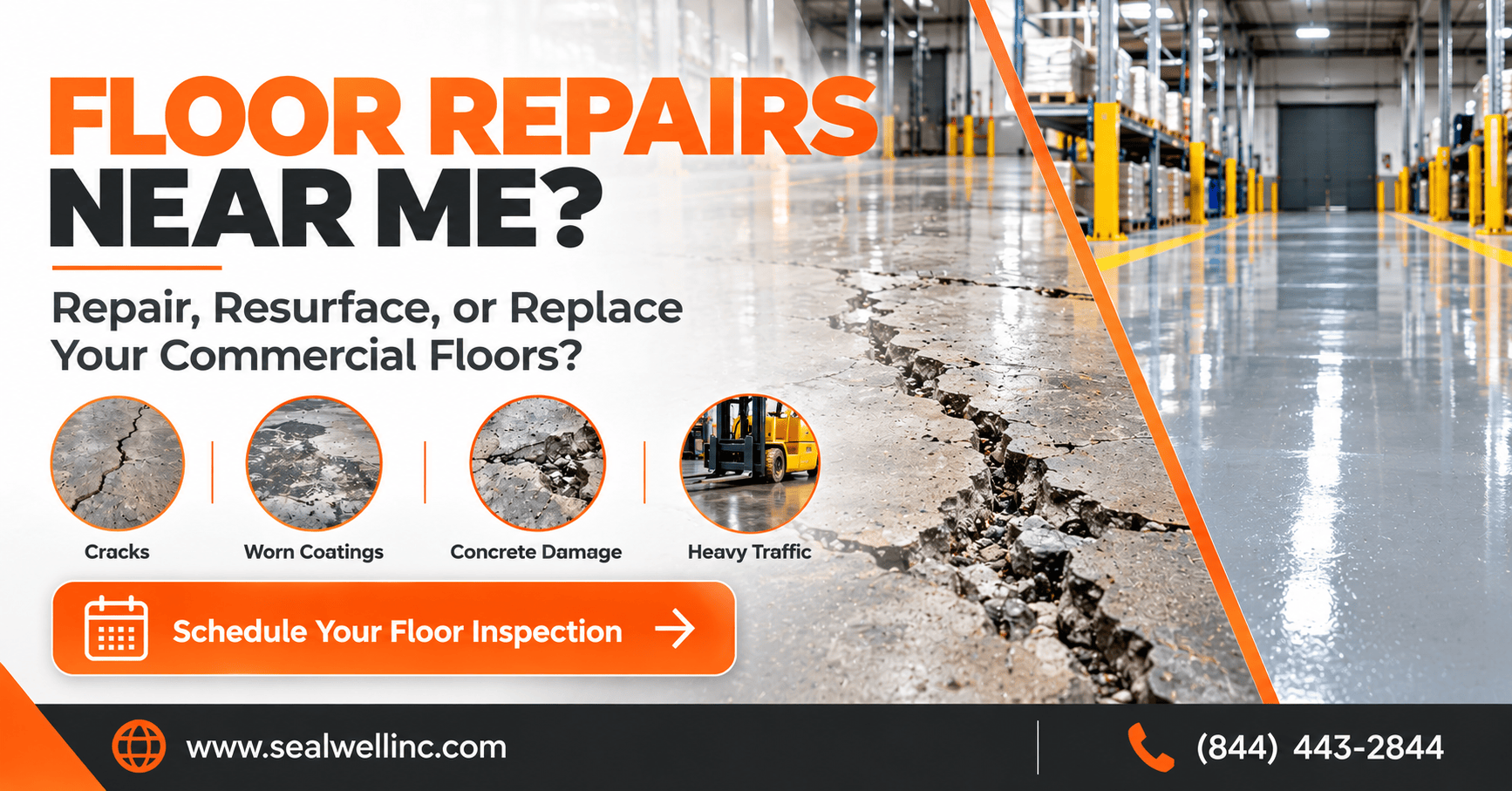
Searching for Floor Repairs Near Me usually means something is already going wrong with your commercial or industrial flooring. Cracks may be spreading across a warehouse floor, an epoxy coating may be peeling, concrete may be breaking apart around expansion joints, or worn surfaces may be affecting daily operations. The important question is not simply who can fix the problem, but whether your facility needs targeted repairs, complete resurfacing, or full floor replacement.
For facility managers, property owners, and operations teams, making the right decision can help control maintenance costs, reduce operational downtime, and extend the useful life of existing flooring.
However, not every damaged floor requires replacement. In many cases, localized repairs or resurfacing can restore performance without the disruption associated with removing an entire flooring system.
Understanding the differences between these options is the first step toward making a practical, cost-effective flooring decision.
Quick Answer: Should You Repair, Resurface, or Replace a Commercial Floor?
Repair a commercial floor when damage is localized, resurface it when deterioration is widespread but the underlying concrete remains suitable, and consider replacement when extensive structural damage or other conditions make restoration impractical.
The correct choice depends on the concrete condition, severity of damage, traffic demands, moisture exposure, existing flooring system, and operational requirements.
A professional floor inspection can help determine which approach is appropriate.
Commercial Floor Repair vs. Resurfacing vs. Replacement
|
Factor |
Floor Repair |
Floor Resurfacing |
Floor Replacement |
|
Best For |
Localized cracks, spalls and damaged joints |
Widespread surface wear and coating deterioration |
Extensive damage or unsuitable existing flooring |
|
Scope of Work |
Specific damaged sections |
Larger portions of the existing floor |
Removal and installation of the affected flooring system |
|
Existing Concrete |
Generally suitable outside damaged areas |
Must be suitable for restoration |
May require significant reconstruction |
|
Relative Cost |
Often lowest for limited damage |
Often moderate, depending on preparation |
Often highest for extensive work |
|
Operational Downtime |
Usually limited for small repairs |
Depends on area and curing requirements |
Can require substantial coordination |
|
Main Benefit |
Addresses isolated defects |
Restores a larger worn surface |
Provides a new system where restoration is unsuitable |
|
Professional Inspection |
Recommended |
Important |
Essential for defining the full scope |
Important: These comparisons are general. A large repair project may cost more than a small resurfacing project, and some replacement projects involve only the coating system rather than the concrete slab.
- When Should You Repair a Commercial Floor?
Commercial floor repair is generally appropriate when the existing flooring remains serviceable but certain areas have developed damage.
For example, a warehouse may have a damaged concrete joint where forklifts repeatedly cross, while the surrounding floor remains in acceptable condition.
Similarly, a manufacturing facility may have localized coating damage caused by chemical exposure or impact.
In these situations, targeted repairs may be more practical than replacing the entire flooring system.
Common Signs Your Commercial Floor Needs Repairs
- Cracks in concrete surfaces
- Localized concrete spalling
- Damaged control or construction joints
- Small areas of peeling epoxy
- Surface chips and holes
- Isolated impact damage
- Uneven transitions
- Deteriorated patches from previous repairs
- Localized wear around machinery
What Are the Benefits of Professional Floor Repairs?
Lower disruption: Repairs can sometimes be completed in specific work areas without closing the entire facility.
Targeted investment: Facility managers can address the damaged sections rather than automatically replacing a larger area.
Reduced risk of deterioration: Timely repairs may help prevent certain defects from becoming more extensive.
Better maintenance planning: Localized repairs can be incorporated into an ongoing facility maintenance program.
However, a repair is only effective when the underlying cause of damage is understood.
A crack caused by ongoing slab movement, for example, may require a different approach from a superficial surface defect.
- When Is Commercial Floor Resurfacing the Better Option?
Floor resurfacing may be appropriate when a large portion of the floor has deteriorated but the underlying concrete is still suitable for restoration.
Unlike localized repairs, resurfacing addresses a broader area.
The goal is to renew the surface and provide a finish appropriate for the facility’s operating conditions.
Signs Your Facility May Need Floor Resurfacing
- Widespread coating wear
- Multiple areas of surface deterioration
- Dull or uneven flooring finishes
- Repeated localized repairs
- General abrasion from heavy traffic
- Worn warehouse traffic lanes
- Surface damage affecting a large area
- Existing coatings nearing the end of their useful life
What Does Commercial Floor Resurfacing Involve?
The process depends on the existing floor and selected system.
Typical work may include:
- Inspecting the concrete substrate.
- Removing deteriorated or unsuitable coatings.
- Repairing cracks, joints and damaged areas.
- Mechanically preparing the surface.
- Installing a suitable resurfacing or coating system.
- Allowing the new system to cure.
- Completing a final inspection before reopening the area.
Why Choose Resurfacing Instead of Replacement?
When the substrate is suitable, resurfacing may offer several advantages:
- Retaining serviceable concrete
- Renewing worn surfaces
- Improving surface consistency
- Providing an appropriate protective finish
- Avoiding unnecessary demolition
- Coordinating work around operational schedules
However, resurfacing cannot solve every concrete problem.
If the slab has significant structural deterioration, ongoing movement, severe contamination, or unresolved moisture conditions, additional work may be necessary.
- When Should You Replace Commercial or Industrial Flooring?
Replacement becomes a consideration when repairs or resurfacing are unlikely to provide a durable, suitable result.
The term floor replacement can refer to different levels of work.
In some cases, only the existing coating or flooring system needs to be removed and replaced. In more severe situations, damaged concrete may require removal and reconstruction.
Warning Signs That Floor Replacement May Be Necessary
- Extensive concrete deterioration
- Widespread coating delamination
- Severe substrate damage
- Repeated flooring failures
- Unsuitable existing flooring materials
- Major changes in facility operations
- Persistent problems that cannot be corrected through resurfacing
- Damage affecting the floor’s ability to support intended operations
Why Is a Professional Evaluation Important?
A surface that looks severely damaged may still be repairable.
Conversely, a floor that appears relatively intact may have hidden moisture, contamination, or substrate problems.
A professional inspection helps distinguish between surface deterioration and more significant underlying conditions.
This distinction is essential before committing to a major flooring investment.
- What Causes Commercial Floors to Crack, Peel, or Deteriorate?
Understanding the cause of floor damage is just as important as choosing the repair method.
Without identifying the underlying problem, the same damage may return after repairs are completed.
Heavy Equipment and Continuous Traffic
Forklifts, pallet jacks, carts, and machinery place repeated loads on industrial flooring.
Over time, impact and abrasion can contribute to surface wear and joint deterioration.
Moisture Problems
Moisture exposure can affect certain flooring systems, particularly when the selected material or installation conditions are unsuitable.
Chemical Exposure
Cleaning chemicals, oils, acids, solvents, and production materials can deteriorate coatings that are not designed for the exposure.
Poor Surface Preparation
Inadequate preparation can contribute to coating adhesion problems and premature flooring failure.
Temperature Changes
Thermal cycling and extreme temperatures can stress flooring systems, especially when the materials are not appropriate for the environment.
Aging and Deferred Maintenance
Small defects may become more extensive when they remain exposed to traffic, impact, moisture, and other operational stresses.
The best repair strategy addresses both the visible damage and the conditions contributing to it.
- How Much Do Commercial Floor Repairs Cost?
Commercial floor repair costs depend on the project rather than a universal price per square foot.
A small crack repair has very different requirements from restoring an extensively damaged warehouse floor.
Key Factors That Affect Flooring Repair Costs
|
Cost Factor |
Why It Matters |
|
Total Repair Area |
Larger areas may require more labor and materials |
|
Type of Damage |
Cracks, spalling, coating failure and joint damage require different treatments |
|
Concrete Condition |
Weak or contaminated substrates may need additional preparation |
|
Flooring System |
Epoxy, polyurethane, urethane cement and other materials have different requirements |
|
Surface Preparation |
Grinding, shot blasting and coating removal affect project scope |
|
Traffic Requirements |
Heavy-duty applications may require specialized systems |
|
Downtime Restrictions |
Phased or off-hour work can influence scheduling |
|
Accessibility |
Equipment, inventory and restricted work areas may complicate installation |
|
Curing Requirements |
Different materials have different return-to-service timelines |
Is Repair Always Cheaper Than Replacement?
Not necessarily.
Localized repairs are often less expensive than large-scale replacement, but repeatedly repairing a severely deteriorated floor may not be the most economical long-term approach.
Facility managers should compare the immediate project cost with expected performance, maintenance requirements, and potential future repairs.
A professional flooring evaluation can help identify the most practical option.
- How Long Do Commercial Floor Repairs Take?
The repair timeline depends on the size of the damaged area, substrate condition, repair method, selected material, and curing requirements.
Small localized repairs may require relatively short work windows, while extensive resurfacing or replacement can involve several stages.
These may include:
- Site evaluation
- Equipment relocation
- Surface preparation
- Concrete repairs
- Material application
- Curing
- Final inspection
Facilities that operate continuously may need phased work to reduce disruption.
Planning the repair schedule around production requirements is often as important as selecting the flooring material.
- Which Commercial Flooring Systems Are Suitable for Repairs or Resurfacing?
Different environments require different flooring solutions.
Epoxy Flooring
Epoxy systems can provide durable, seamless surfaces for suitable warehouses, manufacturing facilities, commercial spaces, and other industrial environments.
They may be appropriate for renewing floors that require protective coatings, chemical resistance, or improved appearance.
Polyurethane Flooring
Polyurethane flooring systems may be considered where specific wear, flexibility, chemical, or environmental performance characteristics are needed.
Urethane Cement Flooring
Urethane cement is commonly considered for demanding environments involving moisture, thermal cycling, impact, and frequent cleaning.
Polished Concrete
Polished concrete may be appropriate when an existing slab is suitable for grinding, honing, and polishing.
It can provide a durable finished surface without requiring a conventional resinous coating.
Concrete Repair and Resurfacing Systems
Specialized repair materials can be used to address cracks, spalls, damaged joints, and deteriorated concrete before a suitable finish is installed.
The correct system depends on the existing substrate and how the facility operates.
- How Can Facility Managers Reduce Flooring Repair Downtime?
Unexpected flooring repairs can interfere with production, inventory movement, and employee access.
Planning ahead can help reduce disruption.
Practical Ways to Minimize Downtime
Schedule inspections early: Identify developing damage before it becomes more extensive.
Prioritize high-risk areas: Focus on damaged joints, heavy-traffic lanes, and locations where floor deterioration affects operations.
Consider phased repairs: Divide the work into zones when facility conditions allow.
Coordinate with production teams: Schedule work during maintenance windows or planned shutdowns.
Select appropriate materials: Consider both flooring performance and curing requirements.
Maintain clear access: Move equipment and inventory before contractors begin work.
Follow reopening requirements: Do not resume heavy traffic until the flooring system is ready.
A realistic project schedule helps facility managers balance flooring needs with operational demands.
- How Do You Find the Right Commercial Floor Repair Contractor Near You?
When searching for Floor Repairs Near Me, facility managers should look beyond proximity alone.
The contractor should understand commercial and industrial flooring conditions and be able to evaluate the existing substrate before recommending a solution.
Questions to Ask a Commercial Flooring Contractor
- Do you specialize in commercial and industrial floors?
- Can you inspect the existing concrete before recommending repairs?
- Do you provide crack, joint, and concrete repair services?
- Can you evaluate whether resurfacing is suitable?
- Which flooring systems do you install?
- Can you work around facility operating schedules?
- What surface preparation is included?
- How will curing and reopening requirements be communicated?
- Can you provide a detailed project scope and estimate?
- Do you offer ongoing flooring maintenance recommendations?
A qualified contractor should be able to explain why a particular solution is appropriate for the facility.
- Why Preventive Floor Maintenance Matters
The best time to address flooring problems is often before they become widespread.
Regular inspections can help facility managers identify cracks, coating wear, damaged joints, moisture concerns, and other conditions that may require attention.
A preventive maintenance program may include:
- Routine floor cleaning
- Periodic visual inspections
- Crack and joint monitoring
- Prompt spill cleanup
- Coating condition evaluations
- Localized repairs
- Scheduled professional inspections
- Resurfacing when appropriate
Maintenance frequency should reflect the facility’s traffic, chemicals, moisture, equipment, flooring system, and operational conditions.
Proactive maintenance can help preserve floor performance and make future flooring expenses more predictable.
Why Choose Sealwell Team Experts for Commercial Floor Repairs?
Commercial and industrial flooring problems require more than a temporary surface fix.
The Sealwell team focuses on understanding the existing floor condition, the facility’s operational requirements, and the most appropriate approach to repair, resurfacing, or replacement.
Sealwell provides commercial and industrial flooring solutions for facilities dealing with:
- Cracked concrete
- Damaged floor joints
- Worn epoxy coatings
- Concrete spalling
- Heavy-traffic deterioration
- Surface damage
- Flooring maintenance needs
- Floor resurfacing requirements
- New flooring installation projects
The appropriate solution depends on the substrate condition, damage severity, environmental exposure, traffic demands, and available downtime.
Frequently Asked Questions
Should I repair or replace my commercial floor?
Repair is generally appropriate when damage is localized and the surrounding floor remains suitable for use. Replacement may be necessary when deterioration is extensive or the existing system cannot be restored reliably. A professional inspection can help determine the right option.
What is the difference between floor repair and floor resurfacing?
Floor repair addresses specific damaged areas, such as cracks, joints, or spalling. Resurfacing renews a larger section of an existing floor when the underlying substrate is suitable for restoration.
Is it cheaper to repair or replace commercial flooring?
Localized repairs are often less expensive than complete replacement. However, repeated repairs to a severely damaged floor may cost more over time. The best option depends on damage severity, substrate condition, and expected performance.
Can damaged concrete floors be repaired?
Yes. Many cracks, spalls, damaged joints, and surface defects can be repaired using appropriate concrete repair materials and methods. The suitability of repair depends on the underlying cause and extent of damage.
Can epoxy floors be repaired without replacing the entire coating?
In some cases, localized epoxy damage can be repaired. Widespread peeling, delamination, or substrate problems may require more extensive preparation, recoating, or replacement.
When should a warehouse floor be resurfaced?
Warehouse resurfacing may be appropriate when traffic lanes, coatings, or large surface areas show significant wear but the underlying concrete remains suitable for restoration.
What causes commercial epoxy flooring to peel?
Potential causes include inadequate surface preparation, moisture, contamination, unsuitable product selection, application problems, or operating conditions beyond the flooring system’s capabilities.
How long do commercial floor repairs take?
Repair duration depends on project size, damage severity, surface preparation, repair materials, and curing requirements. Small repairs may require short work windows, while larger projects may take several days or longer.
Can floor repairs be completed while a facility remains operational?
Some projects can be completed in phases while other areas remain operational. Feasibility depends on site access, safety requirements, repair methods, curing, and traffic restrictions.
What is the best flooring repair solution for heavy forklift traffic?
The appropriate solution depends on the damage and existing substrate. Heavy forklift areas may require specialized joint repairs, concrete restoration, or durable flooring systems designed for repeated traffic and impact.
How often should industrial floors be inspected?
Inspection frequency depends on equipment loads, traffic, chemical exposure, moisture, flooring condition, and maintenance history. High-use areas may require more frequent monitoring.
How do I find commercial floor repair contractors near me?
Search for contractors specializing in commercial and industrial flooring, review their service areas and relevant project experience, and request a professional site inspection before selecting a repair solution.
Can resurfacing extend the life of commercial concrete floors?
Resurfacing can extend the useful life of suitable floors by restoring worn surfaces and providing an appropriate protective finish. Results depend on substrate condition, material selection, installation quality, and ongoing maintenance.
Does Sealwell provide commercial and industrial floor repairs?
Sealwell provides commercial and industrial flooring solutions, including concrete repairs, resurfacing, protective flooring systems, and maintenance-related services. Contact the team to discuss your facility’s needs and confirm service availability in your area.
How can I request a commercial floor inspection from Sealwell?
Visit Sealwell’s website and complete the contact form with your facility location, flooring concerns, and project requirements. The team can discuss the next steps for a site visit and floor evaluation.
Talk to a Sealwell Flooring Expert
Not sure whether your commercial floor needs repair, resurfacing, or replacement?
Avoid making a major flooring investment before understanding the condition of your existing floor.
Connect with the Sealwell team to discuss your facility’s flooring challenges and identify an appropriate next step.
Fill out the form on this page to connect with a Sealwell flooring expert and schedule a facility visit, professional floor inspection, and maintenance evaluation.
The team can review your floor conditions, discuss repair and resurfacing options, and help you plan a practical flooring solution.
Our trusted clients: